Claude for Solopreneurs: The Complete Guide
Last updated August 2026

You're the marketing team, the sales team, the customer service team, and the one trying to remember if you replied to that DM from Tuesday. Most AI advice doesn't get built for that. It gets built to solve coordination problems, getting work between people across departments.
You don't have departments to coordinate. You have volume: too much of the same work, for one person, done over and over. So when you read the typical "how to use Claude for business" articles, most of the use cases don't fit your week.
Here's what does: not just faster work, but entire functions running in the background that you couldn't justify hiring for and never had time to build yourself.
One thing first, if the business itself doesn't exist yet: start with How to Start a Business With Claude instead. It covers pressure-testing the idea and drafting your first offer before you have a customer. If you're already running and just want to know what changes once Claude is actually carrying real work in it, keep going.
A couple of years ago, drafting a sales page took me days. Now I draft one in under an hour. But that's actually not the bit that matters. The bit that matters is what happens with the rest of my week. There's a Pinterest strategy running that I never had time to build before AI. My email list gets a regular cadence instead of going dark for six weeks at a time. The work that used to fill my Tuesday is happening quietly in the background while I'm at school pickup.
That's what I want to talk about here. Not "what is Claude" or "should you switch from ChatGPT." I've already written about both, and I'll link to those below.
The question I want to answer is this: what does your business actually look like when Claude is carrying real work? And what becomes possible that wasn't before?
The short version:
Most AI education was built for businesses with teams. Solopreneurs are an afterthought, and the use cases being taught don't match your week.
Two things change when you run Claude properly. The work you already do gets compressed. And entire functions you couldn't run before become possible.
The unlock is the bigger story. A Pinterest strategy you never had time to build. An email cadence that doesn't depend on your energy. Sales pages drafting in under an hour, which means you can launch more often.
The thinking that makes this possible matters more than any specific feature. It's the difference between someone who chats with AI and someone who architects systems with it.
You don't need to be technical. You need to know what to build, what context to give it, and what should stay manual.
New here? This blog is for the solo founder who wears every hat in the business, and wants real AI systems and workflows running things, not just piecing it together in the chat. Start here →
Here’s what we’re covering:
Why most AI advice doesn't work for solopreneurs
Most AI content assumes a business with departments, a sales pipeline, inventory, or a support queue. It's solving coordination problems, getting work between people. You don't have people to coordinate. You have volume: too much of the same work, done over and over, with nobody to hand it to.
That's not a smaller version of the enterprise problem. It's a different problem entirely, which is why the popular use cases don't just need scaling down for you. They don't apply at all. Proposal automation. Sales call analysis. Lead scoring. Team collaboration workflows. None of it maps to how your week actually looks. You don't need a sales pipeline automated. You need help writing the three emails you've been meaning to send for a fortnight.
So what ends up happening is you read articles, sign up for courses, watch tutorials, and at some point you realise: every example assumes someone else is doing half the work. That assumption is the gap.
I noticed this properly when I was looking to uplevel my knowledge in the AI space. I'd get close to signing up and then realise that half the program or course was about workflows I'd never need: team operations, sales pipeline automation, blah blah blah. I sat there thinking, "I don't use any of this. And if I don't, my clients definitely don't." That gap is the reason I built what I build now.
That's the lens this guide uses. Everything below assumes you're the one running it all, which means the question isn't "how do I deploy AI across departments." It's "how do I get AI to carry the work I'd hire for, if I could afford to."
What actually changes when you run Claude as a solo founder
Two things change when you actually run Claude properly.
The first is compression. The work you're already doing gets faster. Captions that used to take ninety minutes take ten. A sales page that used to take days takes under an hour. Emails you didn't have the energy to write on a Friday afternoon get drafted on a Tuesday during the school run. This is what most "AI for business" articles talk about, and it's real. You'll feel it within the first week of using Claude properly.
The second is bigger: unlock. Entire functions that weren't possible before start running quietly in the background. A Pinterest strategy you never had time to build. A repurposing workflow that turns one blog post into a week of content across five platforms. A monthly data review you couldn't have done because your Tuesdays were already booked.
Compression is what hooks you. Unlock is what changes the math on whether you can actually scale solo. Most people only see the compression layer because that's what AI education focuses on. The unlock layer is the bit nobody's teaching. And it's the bit that actually shifts what's possible for you.
Compression makes you faster. Unlock makes your business start to look like one with team backing.
The work you were already doing, now compressed
This is the bit you'll feel first. Usually within a week.
Three real numbers from my own business. Drafting a sales page used to take me three days. I'd block out the time, push my client work aside, and grind through the structure, the hooks, the proof, the FAQ, the close. Now I draft a sales page in under an hour. The voice is mine, the structure is sound, the proof is integrated. What I do is direct, decide, and refine. The execution is no longer mine to carry.
Captions used to take me forever. Now they take minutes because the workflow is set up to handle the part that used to slow me down. I bring the idea and the moment. Claude carries the structure, the voice match, the formatting.
Blog posts that used to take an afternoon now draft in a fraction of the time. One of my members told me she got six blog posts done in one afternoon. Before, six blog posts was a quarter's worth of output for her.
These numbers matter, but they're not the whole story. What used to take days now takes under an hour. That's not a productivity tip. It's a different relationship with your week. The hours that used to disappear into draft work are now yours, available for the strategic, creative, judgment-heavy stuff that only you can do. The work AI can't.
The compression layer gives you back time. The question is what you do with the time once it's yours.
The work that wasn't possible before
This is where the bigger story lives.
I never had a Pinterest strategy. Not because I didn't think Pinterest worked. Pinterest drives traffic for years, not days, and any solo founder with content should be on it. I just didn't have the time. The pin design, the batching, the scheduling, the monthly analytics review. It was a function I would have happily hired for if I could have justified it. Now an AI workflow runs it. Pins go from blog post to keyword-optimised pin to scheduled distribution without me having to press send. That function exists in my business now because of AI. It did not exist before.
The same is true for my email list. I used to ghost it. Six weeks would go by and I'd open my email platform and feel a wave of guilt about the people on the other end. Then I'd write something half-hearted to make myself feel better. Now there's a regular cadence. Emails get drafted in my voice from prompts pulled out of what I'm already doing in my business. The list gets emailed because the system runs whether I'm in the mood to email or not.
Some other things running in my business right now that I couldn't have run a year ago:
A repurposing workflow that turns one blog post into a carousel, a set of captions, a reel script, a Pinterest pin set, and a newsletter draft. The kind of thing a content team would do.
A monthly data review that pulls performance metrics, identifies what's working, and surfaces what to do more of and what to drop. A junior analyst function for a business that doesn't have a junior anything.
Sales-page velocity high enough that I can run a launch a month if I want, instead of a launch a quarter. Not because I'm faster at writing. Because the architecture lets me move at a different pace.
These are jobs you'd have hired for if you could afford to. The thing is, most solo founders never reach the revenue point where they could afford to, because the manual work eats the time you'd need to grow past it. AI takes that threshold off the table. The work runs before you'd have justified a hire. And it keeps running while you focus on the stuff that actually needs you.
A member said it to me recently: "I feel like I have a whole marketing team now." That's the unlock. The team is your AI layer.
The unlock layer is what makes scaling solo a real option, not just a nice idea.
How to think about Claude in your business: The Architect Method
Both layers only happen because of how you set Claude up. Not because Claude is powerful. The thinking that makes the difference is what I call the Architect Method. It's a framework for solo founders who want AI actually doing the work, not just sitting in a chat tab waiting to be asked something.
I've written the full breakdown of this thinking in What Is an AI Architect. It's the framework SheScales is built on.
Five stages.
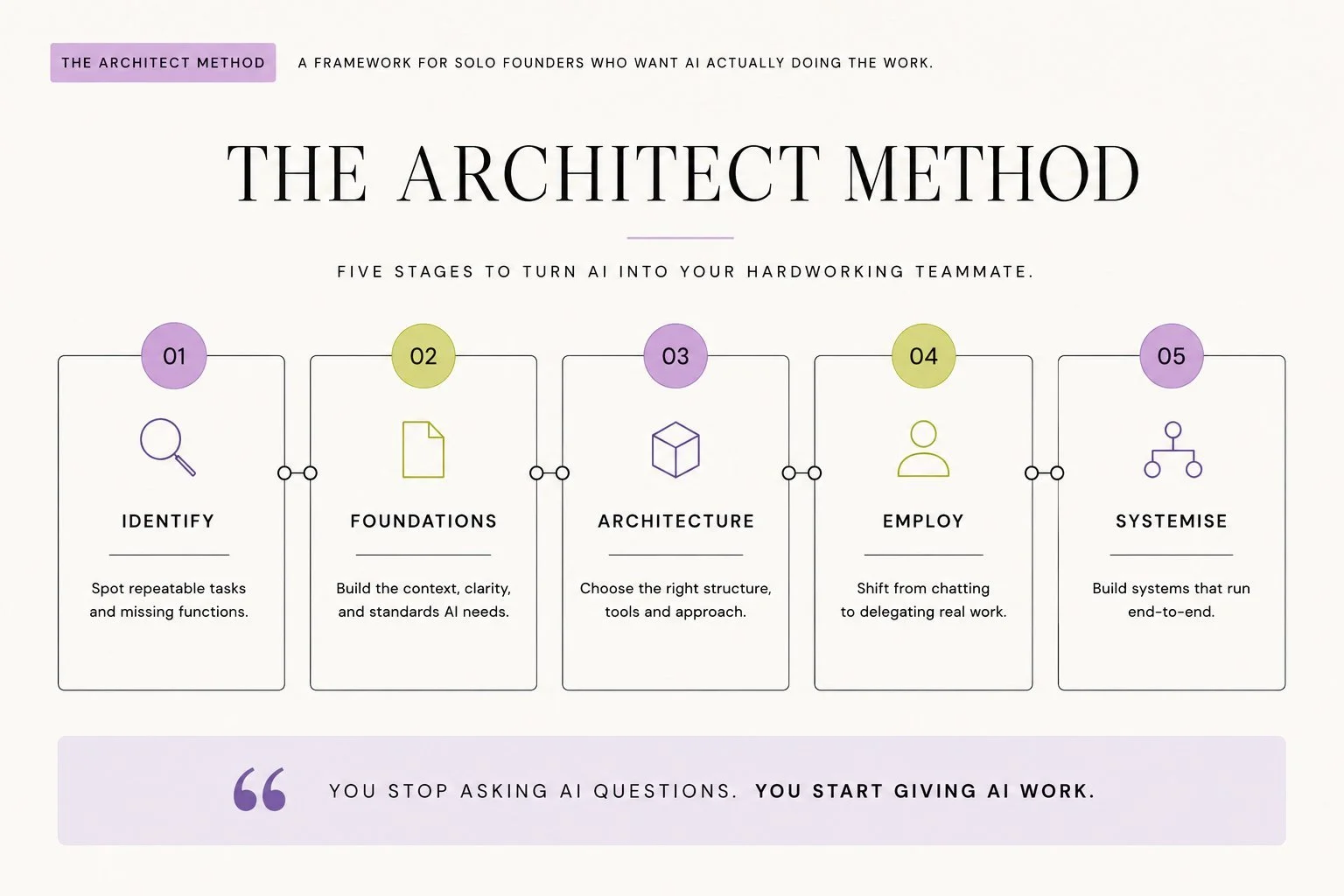
Identifying use cases. Look at your week and your business and spot two things. The tasks that are eating your time (the captions, the emails, the sales pages) and the functions that are missing entirely (the Pinterest strategy you don't have, the data review you can't get to, the follow-up sequence you keep meaning to build). If they are repeatable processes then they qualify and are jobs for AI.
Knowing what to build. Once you've spotted a use case, work out what context AI needs to do the job well. This is the foundations layer. Your brand voice. Your audience. Your offers. Your standards. Your "never say" list. AI doesn't create clarity. It amplifies whatever's already there. If your foundations are vague, AI will produce vague output faster. If your foundations are documented, AI does the job almost without supervision.
Choosing the right architecture. Decide how to build it. Is this a Skill (a piece of reusable knowledge AI carries into every conversation)? A Project (a workspace with persistent context for one specific job)? A multi-step workflow that connects Claude to other tools? A Cowork task that runs autonomously? Or does this thing actually need to stay manual because the judgment can't be delegated yet? Tool selection matters, but it sits inside a bigger thinking framework.
Shifting from chatting to employing. This is the mindset shift, and it's the hardest one. Most people are still using AI like a search engine with personality. The shift is from "help me write a caption" to "here's your job: produce this week's content using my brand voice, my pillars, and my schedule." You stop asking AI questions. You start giving AI work.
Building systems, not collecting tools. A single tool doing a single job is helpful. A system running an entire function is transformational. The Pinterest workflow I described earlier isn't one tool. It's a connected sequence: blog post in, pins titles and descriptions out, graphics created, pins scheduled, pins posted, tracked. That's a system. Most solo founders are still in the prompt-collecting phase. The win is one system that runs end-to-end.
This is the thinking that transfers across platforms. Tools change. The architecture thinking doesn't. Whatever Claude looks like in twelve months, the framework still works. That's the part worth investing your brain in.
The Architect Method is not about being technical. It's about looking at your business and knowing where AI fits.
Where solopreneurs get stuck (and how to skip the trap)
Three traps catch almost everyone in their first month with Claude.
The first is collecting prompts and templates. You scroll, you save, you download. You build a Notion doc full of prompt packs. It feels productive, but you never actually implement any of them. The fix is to stop saving and start building. One workflow, fully set up, will outperform a thousand saved prompts.
The second is stopping at the chat box. Quick questions, no context, generic answers. You re-type your audience, your voice, your goals every session because you haven't built anything that holds the context for you. The fix is to give Claude a place to work, not just a question to answer. A Project with proper context will out-perform a thousand carefully crafted prompts.
The third is trying to redesign your whole business in one weekend. You decide AI is going to fix everything, you sit down on a Saturday with a list of fifteen workflows you want to build, and by Sunday afternoon you've got eight half-built things and a headache. The fix is patience. Solo founders don't have the bandwidth to build a complete AI infrastructure in one go. You build one piece, prove it works, then add the next. The momentum compounds.
The thread running through all three traps is the same. AI rewards architects, not collectors. The hour you spend setting one workflow up properly is worth fifty hours of saving prompts you'll never use.
Better setups beat better prompts every time.
Where to start as a solo founder
The starting move is small. One task. One workflow. One week.
Pick one task that's eating your time and that you do every week. Captions. Weekly emails. Sales-page drafts. Client onboarding messages. Pick the thing you do the most often that you also resent doing and is a repeatable system you could teach someone to do.
Document the brief. You need every single step, every rule, every minute detail.
Set up a Claude Project with that brief loaded in. Persistent context, every conversation in that workspace inherits it.
Use that one Project for that one task for a week. Don't build five things. Use this one until it's reliable.
Then expand. Add a second task. Add a Skill. Connect to one tool you already use.
This is the same advice I give every new SheScales member. The members who get the best results are the ones who start small and let momentum carry them, not the ones who try to systemise everything at once.
If you want the platform-level context for Claude itself (how it differs from ChatGPT, what features matter, how to avoid the early mistakes), three posts cover those angles in depth:
ChatGPT vs Claude for Business: How I Use Both walks through where each platform wins.
New to Claude: What I Wished I'd Known Sooner covers the early learning curve, usage limits, and how Claude prompting differs.
How to Actually Use Claude for Business covers the features most new users miss.
This guide stays focused on the business architecture. Those go deeper on the platform.
The fastest way to learn Claude as a solo founder is to build one workflow with it for one week.

Want Claude properly set up before you build any of this?
The free Claude Setup Kit walks you through every setting worth turning on, how Projects and Skills work, Claude Cowork, and the exact prompt to export your ChatGPT memory so you are not starting from scratch.
It is the guide I wish I had when I started.
FAQ
Is Claude better than ChatGPT for solopreneurs?
For most solopreneur use cases, now, yes. Claude holds business context across sessions through Projects and Skills, writes more naturally in your voice, and pushes back on weak strategy in ways ChatGPT generally doesn't. ChatGPT still wins on the broader ecosystem (image generation, marketplace integrations) and on tasks where speed matters more than depth. Voice mode used to be part of that list; Claude caught up in July 2026, so it's not really a deciding factor anymore. Most solo founders I work with run both. They open Claude first.
Do I need to be technical to use Claude as a solo founder?
No. The Architect Method is a thinking framework, not a coding skill. You need to know what to build, what context to give it, and when something should stay manual. None of that requires writing code. I'm not technical, and the work happens through plain English instructions inside Projects and Skills. The skill that matters is knowing your business well enough to describe it clearly.
How long does it take to see results?
Most solo founders feel the compression layer (faster work) within the first week of building one Project properly. The unlock layer (new functions running in the business) takes longer because you're building infrastructure, not just speeding up what you already do. Expect three to six weeks for the first real system to be running reliably, and the rate compounds from there.
Will Claude actually sound like me?
Only if you train it properly. Generic prompts give generic output. A Claude Project loaded with your voice rules, your "never say" list, examples of what good looks like, and context about your audience will produce writing your readers can't tell you didn't write yourself. The bottleneck is almost always missing foundations, not Claude.
What if I've tried AI before and it didn't work?
The most common reason AI fails for solo founders is that it was being used at the prompt level instead of the system level. Quick questions in a chat box, no saved context, no documented foundations. The platform isn't broken. The setup is. Rebuilding the same task as a Project with proper context usually closes the gap entirely.
Where do I start if my brand isn't documented yet?
Start with the foundations. Spend a session writing down your voice, your audience, your offers, the things you'd never say, and three examples of writing you'd be proud to publish. That document becomes the brief you give Claude in every Project. It also tends to surface the gaps in your own thinking that have been quietly limiting your output. Foundations work feels slow. It's the most valuable thing you'll do for your AI layer.
Is this just for content businesses, or does it apply to service businesses too?
It applies to both. The compression and unlock layers play out differently depending on what your business does, but the framework is the same. Service businesses tend to see the biggest unlocks in client communications, proposals, follow-ups, and admin. Content businesses see them in repurposing, distribution, and email cadence. Solo founders selling products see them in launch velocity and listing operations. The thinking is identical. The use cases vary.
key takeaways
If you take one thing from this post, make it this: solopreneurs who use Claude to architect their business beat solopreneurs who use Claude to chat.
The advice is built for teams. Most AI education assumes you have departments, a sales pipeline, and a marketing team. Solopreneurs need a different lens: AI as the team you built instead of hired.
Compression is the entry point, unlock is the story. Faster captions and quicker sales pages are real, but the bigger shift is functions running in your business that weren't possible before and that you didn't need to hire for.
The Architect Method is the differentiator. Identifying use cases, documenting foundations, choosing architecture, employing AI rather than chatting with it, and building systems rather than collecting tools. This thinking transfers across every platform change.
Foundations come first. AI doesn't create clarity. It amplifies whatever's already there. Document your voice, audience, offers, and standards before you try to scale anything with AI.
One workflow, one week, then expand. The solo founders who actually transform their business with AI start small, prove momentum, and compound. The ones who try to redesign everything at once burn out within a month.
What to Do Next
If you've read this far, you don't need another article about Claude. You need to actually build something inside it.
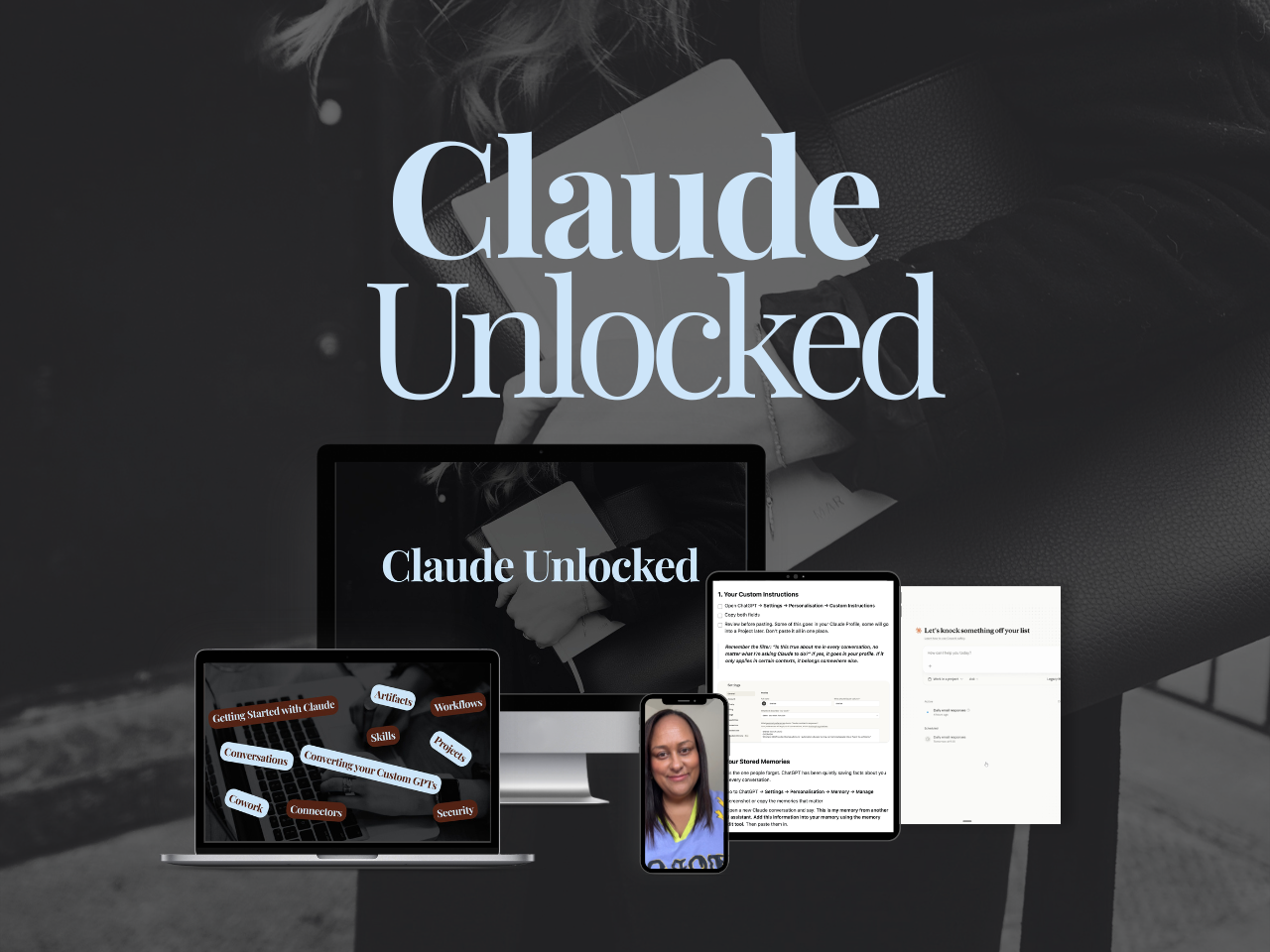
If you want a structured way to learn Claude properly without piecing it together from blog posts, Claude Unlocked is the front-end product I built for that. It walks through Projects, Skills, Connectors, and Cowork in the order they actually matter for a business owner, and it's $47.
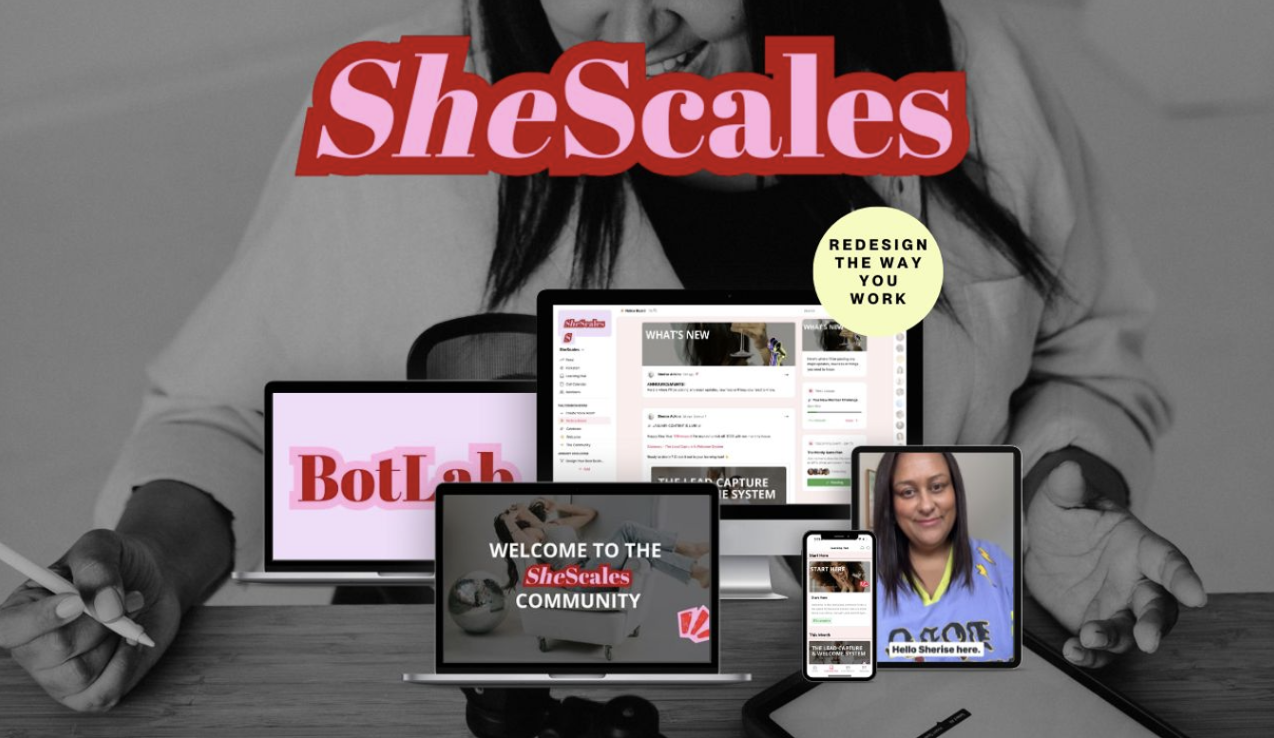
If you've already hit the limits of "using Claude better" and you want to start architecting real systems with support, SheScales is the implementation community I run for solo founders who are done collecting tools.
Each month I build a new system in my own business, pull it apart, explain every decision, and hand over every component so you can build your version. It's for builders, not browsers.
The starting point is the same either way: stop asking Claude to help. Start giving Claude a job.
Less manual everything.
MEET THE AUTHOR

HEY, I'M SHERISE
I'm an AI strategist and educator based on the Central Coast of NSW, Australia. I help solo founders install AI systems that scale their business without scaling their workload and remove low-value work from their business so they can spend more time in strategy, creativity, and the work that actually moves the needle.
I run SheScales, the AI implementation community built for the person who IS the business and the whole team. I'm the founder behind 40+ AI assistants across ChatGPT and Claude, the Brand Playbook App, and a growing library of skills and systems used daily by hundreds of solo businesses.
I teach the Architect Method: the shift from chatting with AI to giving AI a job. It's the thinking framework for spotting where AI can genuinely help in your business, knowing how to architect the system, and deciding whether something should be a Skill, a Project, a GPT, an automation, a combination of these, or stay manual.
I'm not here to inspire you. I'm here to hand you the architecture.