The One Thing Missing from Every AI Course I've Taken (And What I Built Instead)
Last updated August 2026
I've bought a fair few AI courses because I’m not naive enough to think that there’s anyone on the planet who knows all there is to know about AI, and I’m so happy to learn from those who are further ahead than me.
I’ve also left a fair few of them behind because I started noticing the same thing when I’d scroll the sales page. And that was that only around half of what they were teaching would apply to my business because I’m a solo founder who doesn’t have a $10k per month marketing budget, or employees let alone a sales team.
The use cases they were teaching were things like proposal automation, sales systems, and summarising the meetings I don't have, for the team I don't have, in the CRM I don't use.
I kept waiting for the part that was built for me. The person who is the founder, the marketing department, the client manager, and the support team, all at once. It never came.
That gap is the whole reason SheScales exists. But it took me a while to work out that the problem was that almost nobody is building AI education for the way a solo founder actually spends their week.
Every AI course I've taken was missing the same thing: it was built for businesses with teams or big budgets and programs I just didn’t use in my business. For a solo founder who is the entire team, most of that content doesn't apply. The gap isn't your skill level. It's who the course was designed for.
TL;DR:
Every AI course tends to teach the same use cases that just aren’t geared towards solo founders who are the entire team.
A solo founder has no handoffs. You're the whole team, so most of that content doesn't transfer, and it's easy to wrongly conclude you're the one falling behind.
The gap is structural, not personal. The courses were built for a different kind of business, not for the person who runs every function alone.
What solo founders actually need is AI pointed at the work a team would have done: content, client delivery, email, admin. And a way to decide what to build, not just which buttons to press.
That gap is why I built SheScales: AI implementation built specifically for the person who IS the business, with a real system handed over every month.
New here? This blog is for the solo founder who wears every hat in the business, and wants real AI systems and workflows running things, not just piecing it together in the chat. Start here →
The Pattern I Kept Noticing
The courses themselves were good. I want to be clear about that, because this isn't a takedown. They were well made, taught by people who clearly knew their material, and full of genuinely useful ideas.
The ideas just weren't for me.
Every course followed roughly the same shape. Start with the basics, build toward the impressive stuff, and the impressive stuff was almost always targeted to bigger businesses like Real Estate Agents and Marketing Agencies.
I'd sit there thinking: This isn’t what I need. I need AI to do the work the people would have done, if I had any.
That's a completely different problem.
Solo founders aren't a smaller version of a company with a team. They're a different kind of business entirely, with a different set of problems. Most AI education has never made that distinction.
The Moment It Clicked
There was one course in particular where it properly landed. It was being delivered by someone who was technical…not someone who was good at business, let alone business as a solo founder.
I had this very specific thought, sitting there with the video paused: I don't use any of this. And if I don't, my clients definitely don't.
Because at that point I was working with a lot of solo founders, and I knew their businesses. I knew their weeks. They had themselves, a laptop, a long list, and a quiet worry that they were falling behind on AI while everyone online seemed to be racing ahead.
That was the moment the gap turned into something I could name. The AI education market was building for businesses with teams, and the fastest-growing segment of business owners, the solo founders, the one-person operations, were being handed content designed for somebody else entirely.
So they'd do what I did. Sit through it, absorb the bits that transferred, and feel dissatisfied.
They weren't the problem. The curriculum was.
The gap between a prompt you reuse and a system that runs without you is the whole distinction. AI Prompts vs AI Systems covers what to build first.
What's Actually Being Taught (And Who For)
Let me be specific, because the gap is clearest when you see it laid out.
Here's the kind of thing that dominates most AI education right now:
Automating proposals across a sales team
Lead scoring and CRM enrichment for a pipeline
Meeting summaries and action-item routing (you don't have meetings, you are the meeting)
Internal knowledge bases for onboarding new staff
Now here's a solo founder's actual week: writing content, sending emails, managing clients, onboarding clients, building offers, tweaking the website, chasing an invoice, posting on social, replying to DMs, and trying to remember whether they published that blog post or just thought about it really hard.
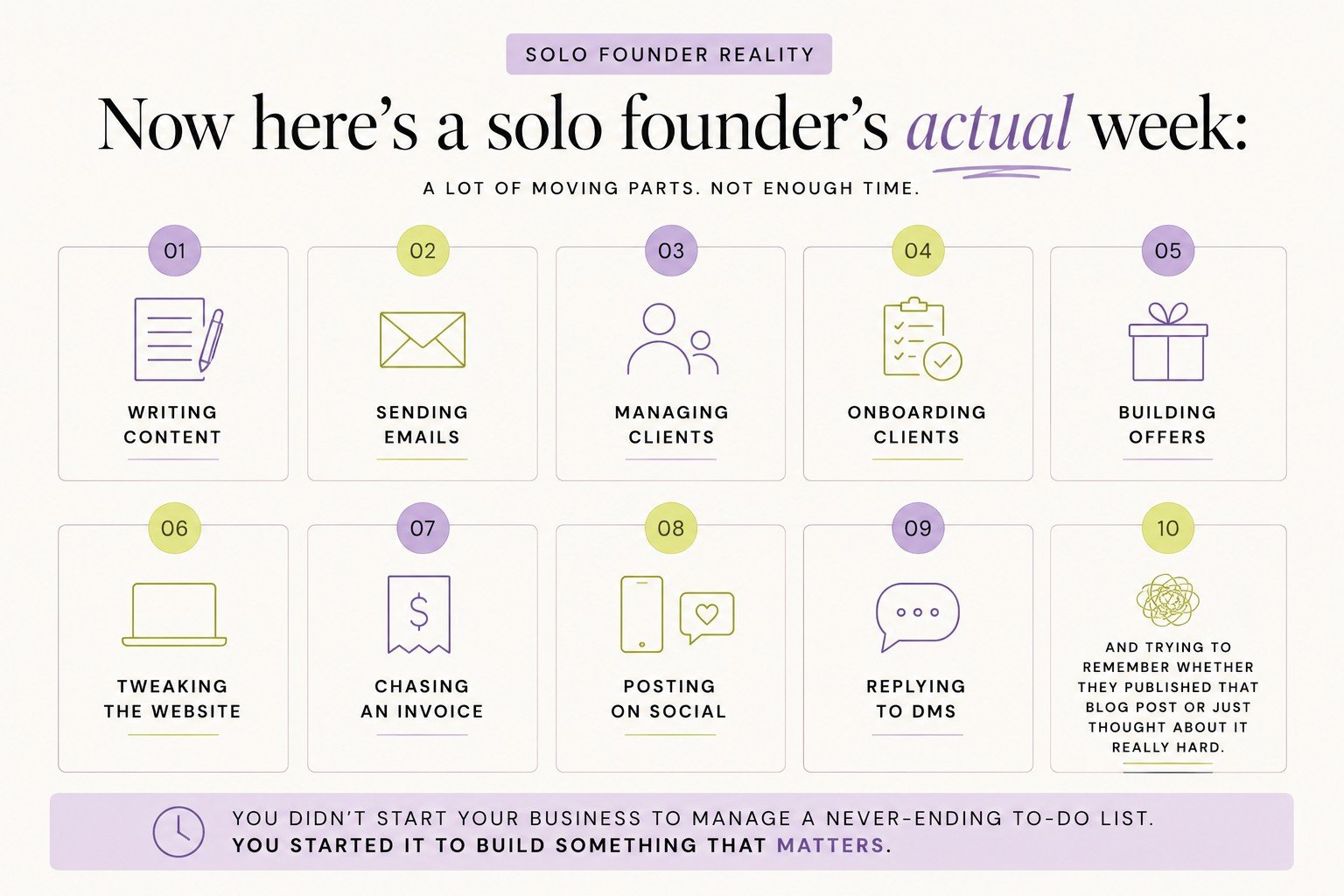
You're not managing a team. You ARE the team. Spot the use case in that list that involves a handoff to another person. There isn't one.
That's the mismatch. It's not that solo founders need simpler AI. They need AI pointed at completely different work: the functions a team would have covered, now run by one person who needs the help more than anyone, and gets taught for it the least.
The real gap: It was never about skill level or being technical. It's that the use cases being taught assume a business structure solo founders don't have. Different structure, different problems, different brief entirely.
I've since written the full breakdown of why this happens and what actually works instead. Why AI Education Fails Solo Founders goes into the whole thing.
What Solo Founders Actually Need
So what should AI education for a solo founder actually cover?
Here's what I kept wishing those courses had taught me:
How to build a content system that runs the whole function, including scheduling it out.
How to get AI to sound like me specifically.
How to set up client onboarding that delivers the same experience every time.
How to have AI brief me my priorities in the morning so I sit down and know exactly where to focus.
How to get AI to reliably triage and respond to my emails.
How to get AI to do the reporting that’s eating up my time.
How to decide what to build in the first place. That's the one almost nobody teaches. Not "here's how to make a Claude Project" but "here's how to look at your business and work out which function should become a system, and which should stay manual."
And underneath all of it, the thing I needed most: how to stop using AI as a thing I occasionally ask for help, and start giving it actual jobs. A defined role. Real context about how I work. Outputs I can rely on without rewriting them every time.
That shift, from asking AI for help to giving AI a job, is the whole game. I wrote about the thinking framework behind it in What Is an AI Architect, if you want the full version.
None of that requires you to be technical. I'm not technical. It requires you to understand your own business well enough to tell AI what good looks like, and a framework for deciding what to build. That's it.
Want the full Claude setup laid out step by step?
This free kit covers every setting worth turning on, how Projects and Skills work, and the exact prompt to export your ChatGPT memory so you're not starting from scratch.
It's the guide I wish I had when I started.
What I Built Instead
I built the thing I kept looking for and couldn't find.
SheScales is an AI implementation community built specifically for solo founders.
Not "solo-founder-friendly." Not "works for small teams too." Built for the person who is the business, the marketing department, the content creator, the client manager, and the CEO, all at once.
Here's how it works. Every month, I pull apart an actual AI system that I have running inside my own business and explain every decision: why I structured it that way, what I tried that didn't work, what I'd do differently. Then I hand over every component so members can install it and customise it to their business with my support.
The use cases are the ones that actually exist in a solo founder's week. Content systems that take a brief on Monday and have posts scheduled by Tuesday. Client onboarding that runs without you. Email that drafts in your voice while you're on the school run. Pinterest strategies that batch a whole month in an afternoon.
That's not a list of things that might be possible one day. That's what members are building right now.
SheScales is built on one belief: most AI education is built for businesses with teams. I build for the person who IS the team. Everything inside it is designed for a one-person business, not adapted down from enterprise content.
And the members getting the best results aren't the most technical people in the room. They're the ones who did the foundational work first, their brand voice, their offers, their standards, then built systems on top of something solid.
There's a bigger reason this matters too. AI is being shaped right now by who's in the room building with it. If solo founders, and especially the women running one-person businesses, aren't in that room, testing and building and saying out loud what works and what doesn't, the tools keep getting designed for someone else. Being part of this now isn't only about saving yourself time. It's about having a say in where it all goes.
Key Takeaways
The short version of everything above:
The gap is structural, not personal: Most AI courses are built for businesses with teams. If the content hasn't worked for you as a solo founder, it's because it was designed for a different kind of business, not because you're behind.
The tell is the handoff: A solo founder's week has no handoffs. That single difference is why most courses don't transfer.
You need AI pointed at different work: Not simpler AI. AI aimed at the functions a team would have covered, now run by one person: content, client delivery, email, admin, research etc.
Deciding what to build is the missing skill: Most courses teach the tools. Almost none teach how to look at your business and decide which function should become a system and which should stay manual.
Foundation before tools: The members who get the best results build their brand voice, offers, and standards first, then build systems on top. Context beats tool selection every time.
Frequently Asked Questions
Why don't most AI courses work for solo founders?
Most AI courses are built for businesses with teams. The use cases assume employees, departments, and handoffs between people: proposal automation across a sales team, lead routing, meeting summaries, multi-person content workflows. A solo founder is one person covering every function, so the workflows don't transfer. The structure they're built on doesn't exist in a one-person business.
Is the problem that I'm not technical enough?
Almost certainly not. The gap in most AI education isn't technical depth, it's audience fit. The content assumes a business structure with multiple people in it. Getting results from AI as a solo founder comes from understanding your own business well enough to brief AI properly and knowing what to build, both of which are business skills, not technical ones.
What's different about how SheScales teaches AI?
SheScales is built specifically for solo founders, not adapted from team-focused content. Each month, Sherise builds a real system inside her own business, explains every decision, and hands over every component so members can build their own version. Every use case is one that exists in a one-person business: content systems, client onboarding, email, admin. Nothing assumes a team you don't have.
I've taken AI courses before and not implemented much. Why would this be different?
Because the content is built for your actual week, not a business with departments. When the use cases match how you genuinely spend your time, implementation stops feeling like translation work. Most solo founders don't fail to implement because they're lazy or behind. They fail because they were handed content designed for someone else and had to mentally convert all of it first.
Do I need to already understand AI to join SheScales?
You need to be past the very beginning, but not much further. Most members arrive knowing the basics and frustrated that they haven't been able to make AI properly work for their business. If you've never opened an AI tool at all, Claude Unlocked is a better first step. If you've tried and felt the gap this post describes, SheScales is the room.
What to Do Next
If this post named something you've felt but couldn't quite articulate, that the AI advice you've been following wasn't built for your kind of business, trust that. It probably wasn't.
SheScales is where you build the version that is.
It’s my AI implementation community for solo founders where each month, I take a real problem in my business (or a problem a member submitted), build the system that solves it, and hand you every component so you can customise it and set it up in yours.
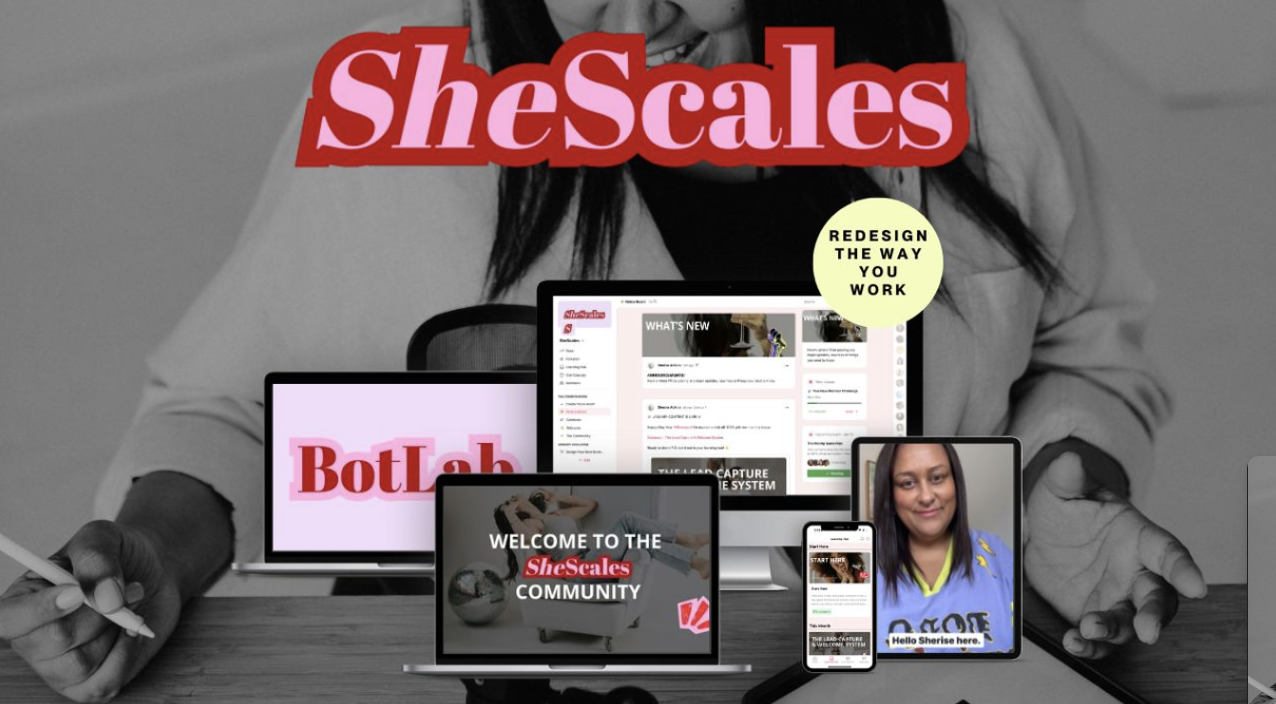
I walk you through it on live calls, I’m in the community daily answering questions, and you’ve got a room full of solo founders building alongside you. The kind of room where things actually get done instead of bookmarked. 🙃
If you've been waiting until you feel more ready, more technical, more caught up, here's the honest version: every month you wait is another month of doing it all manually. The readiness comes from building, not before it.
See you in there.
MEET THE AUTHOR

HEY, I'M SHERISE
I'm an AI strategist and educator based on the Central Coast of NSW, Australia. I help solo founders install AI systems that scale their business without scaling their workload and remove low-value work from their business so they can spend more time in strategy, creativity, and the work that actually moves the needle.
I run SheScales, the AI implementation community built for the person who IS the business and the whole team. I'm the founder behind 40+ AI assistants across ChatGPT and Claude, the Brand Playbook App, and a growing library of skills and systems used daily by hundreds of solo businesses.
I teach the Architect Method: the shift from chatting with AI to giving AI a job. It's the thinking framework for spotting where AI can genuinely help in your business, knowing how to architect the system, and deciding whether something should be a Skill, a Project, a GPT, an automation, a combination of these, or stay manual.
I'm not here to inspire you. I'm here to hand you the architecture.