Why AI Education Fails Solo Founders (And What Actually Works)
Last updated August 2026
A while back I signed up for an AI course that was well structured, well produced, and taught by someone who clearly knew what they were doing. I firmly believe that there’s nobody who knows all there is to know about AI and business, and I’m so happy to learn from those who are further ahead than me.
A few modules in, I hit that specific sinking feeling where you realise the thing you paid for was built for a business that isn't yours. Half of the use cases were built for a business that just wasn’t mine. Good material. But for someone running a very different kind of business to mine.
Because here's what my business actually is: me. I don't have a pipeline to score or a department to route work between. I don't have the problems that course was built to solve. (I have the opposite problem, one person and far too much to do.) I kept going, waiting for it to get to my part. It never did.
It took me longer than I'd like to work out what was actually going on: the course wasn't wrong. It just wasn't built for the kind of business I run, and neither is a lot of what gets taught about AI.
If you've felt that same mismatch, this is why.
AI education mostly fails solo founders for one reason: it's built for the problems a different kind of business has. Inventory, sales pipelines, support queues, ad operations, work moving between people. A solo founder has few of those. A solo founder has volume problems, too much work for one person. The advice doesn't fit because it was solving the wrong problems, not because you're doing something wrong.
TL;DR:
Most AI-for-business content is built for a different kind of business than a solo founder runs: one with inventory, a sales team, a support queue, or ad spend at scale.
Those use cases don't shrink to fit a one-person business. The problems they solve just don't exist in it.
The AI content that does fit a solo founder exists, but it's a small pool, and it's buried under enterprise and agency content, so most people never find it.
If AI hasn't delivered for you, that's almost certainly the reason. It's a fit-and-findability problem, not a you problem.
What works instead: stop asking “what can AI help me with?” and start asking “what function of my business should AI run?” Then build the context (your voice, offers, standards) that lets it.
New here? This blog is for the solo founder who wears every hat in the business, and wants real AI systems and workflows running things, not just piecing it together in the chat. Start here →
Here’s what we’ll be covering:
The Real Problem: Wrong Problems, Not Wrong Size
There's a lot of AI content out there right now, like courses, newsletters, YouTube channels, and paid cohorts. Most of it is genuinely good, if you run the kind of business it was built for.
And that's the catch. “Business owner” and “entrepreneur” have come to mean something specific in AI content: a business with inventory, or a sales team, or a support desk, or a marketing department, or ad spend running across a dozen campaigns. A business with work that moves between people, and problems that come from scale and coordination. When someone builds an AI course for “entrepreneurs,” that's usually the business they're picturing, even if they never say so.
A solo founder runs a different kind of business. Not a smaller version of that one, a different one. You have one brain, one laptop, one week, and roughly forty-seven things that need to happen before Friday.
The loudest AI content was built for businesses with problems you don't have, and the fix was never going to be you trying harder to apply it.
Solo founders weren't the audience this curriculum was built for. We were an afterthought, if we were thought of at all. Not because anyone set out to exclude us, but because the person building the course was picturing a business with a team, a budget, and problems we simply don't have.
What's Actually Being Taught (And Who It Was Built For)
I want to be specific, because most of the AI content isn’t bad. It's just built for a different business.
Here's the kind of thing that dominates the loud, high-visibility layer of AI-for-business content right now:
Proposal automation across a sales team
Lead scoring and CRM enrichment for a sales pipeline
Sales call analysis and meeting summaries (you don't have meetings to summarise, you were on the call)Inventory forecasting and dynamic pricing for a product catalogue
Customer-support-desk automation for hundreds of tickets a day
Ad-spend optimisation across a dozen campaigns
Building an AI automation agency to serve other businesses
AI agents orchestrating work across departments
Look at what every one of those assumes. A sales team. A support queue. A big ad budget. Multiple clients. A department. None of them are a smaller version of a solo founder's problem. They're someone else's problem entirely.
When you're the founder, the marketing team, the content creator, the client manager, and the person doing the actual delivery, all at once, those use cases don't map. You don't need AI to run a support desk you don't have or coordinate a team that doesn't exist. You need AI to do the work the team would have done, if you had one.
The real gap: It's not that solo founders need simpler AI. It's that they need AI aimed at completely different problems: the volume and repetition of running every function yourself, instead of the coordination and scale problems the popular content is built around. Different problems, different brief entirely.
Why You Can't Find the Stuff That Fits
Here's the part that took me the longest to see, and it might be the most important.
It's not that AI content for solo founders doesn't exist. It does. There's a small pool of people genuinely building for one-person businesses, and some of it is good. The problem is you can barely find it.
When you search “AI for my business,” what surfaces first is the loud layer: agency courses, enterprise demos, “build an AI startup” content, viral automation threads showing wild use cases for businesses nothing like yours. The stuff that actually fits a solo founder is sitting underneath all of that, and most people never dig far enough to reach it. They search once, get served content built for someone else, and quietly decide AI isn't for them.
So the gap isn't only that most content is built for the wrong problems. It's that the small amount built for the right ones is hard to find under the noise. Both things are true, and together they're why so many capable solo founders feel behind on AI when they have no reason to be.
What a Solo Founder's Week Actually Looks Like
The disconnect is clearest when you just look at what the week actually contains for a solo founder.
Your week looks like writing content, sending emails, managing clients, building offers, tweaking your website, chasing invoices, posting on social, replying to DMs, and trying to remember whether you published that blog post or just thought about it really hard.
None of that involves a sales team. None of it involves a meeting to summarise or a pipeline to score. What it involves is a lot of the same work, repeated every week, that eats time and energy out of all proportion to its importance. Content that sounds like you. Emails that hit the right tone. Client onboarding that stays consistent even when your attention is somewhere else. That's where AI belongs in a solo founder's business.
I hear it put the same way over and over inside SheScales: “There's still a lot of human glue between steps.” That one phrase captures what the popular AI education keeps failing to solve.
People have learned the tools. They've got prompts, maybe a workflow or two. But they're still the connective tissue holding it all together, manually moving work from one place to the next, because nobody taught them how to build the system that removes the glue.
What Actually Works for Solo Founders
The shift I made, and the shift I teach inside SheScales, isn't about better tools or better prompts. It's about changing the question you ask.
Most AI education teaches you to ask: “What can AI help me with?” That keeps you using AI occasionally, for tasks you remember to hand it, while you stay the person doing all the work.
The question that actually changes things is: “What part of my business should AI be running?” Not helping with. Running. What function could AI own, with a defined scope, real context about how I work, and outputs I can rely on?
That question leads somewhere completely different.
A content system where the research, drafting, formatting, and scheduling run without you touching each step.
A client onboarding flow that delivers the same experience every time no matter what else is going on.
An email system that writes in your voice, not a generic version of you that needs heavy editing before it sounds right.
None of that requires you to be technical. It requires you to understand your business well enough to describe what good looks like: your voice, your standards, your audience, the outputs that actually represent you. AI does the work. You brief it properly, build the structure that holds the brief, and check the output clears the bar.
I've written more about the thinking framework behind this. If you want the full picture, the AI Architect post goes into all five components.
Most courses stop at the prompt. AI Prompts vs AI Systems covers what comes after it.
Why the Approach Matters as Much as the Tools
When people aren't getting good results with AI, they usually go looking for a better tool, a different platform, a different prompt, or a different template. The assumption is that if the output isn't landing, the tool selection is wrong.
Sometimes. But usually the issue is upstream. AI hasn't been given enough about the business to produce output that fits it. It doesn't know your voice, your offers, your audience, what lands with them and what doesn't. Give a vague brief to a powerful tool and you get generic output back. That's not a tool problem. It's a foundation problem.
This is why every SheScales member starts with the Brand Playbook before building anything. Not as a nice branding exercise, but because it's the document that makes everything else work. It's what AI needs to produce output that sounds like you specifically, instead of a polished, generic version of your category.
The tools are almost secondary. I know that sounds wild in a market obsessed with which platform is winning this month. But I've watched someone with a single well-built AI assistant outperform someone with twelve tools, because the one assistant actually has the context to do the job. Context beats capability nearly every time.
And then there are systems. When you stop thinking about AI as just tools and build actual systems and workflows with AI that take actual work off your plate on an automated basis, everything changes.
If you want to see what building on the right foundation looks like in practice, I covered it in how to actually use Claude for business, and the principles apply whichever platform you're on.
Want the full Claude setup laid out step by step?
This free kit covers every setting worth turning on, how Projects and Skills work, and the exact prompt to export your ChatGPT memory so you're not starting from scratch.
It's the guide I wish I'd had when I started.
What SheScales Is (And Who It's Actually For)
I built SheScales because I couldn't find what I needed anywhere else. Every time I recommended an AI course to someone in my community, I had to add “just skip the first few modules, they're not for you.”
That's not good enough, and there are very few people building the alternative.
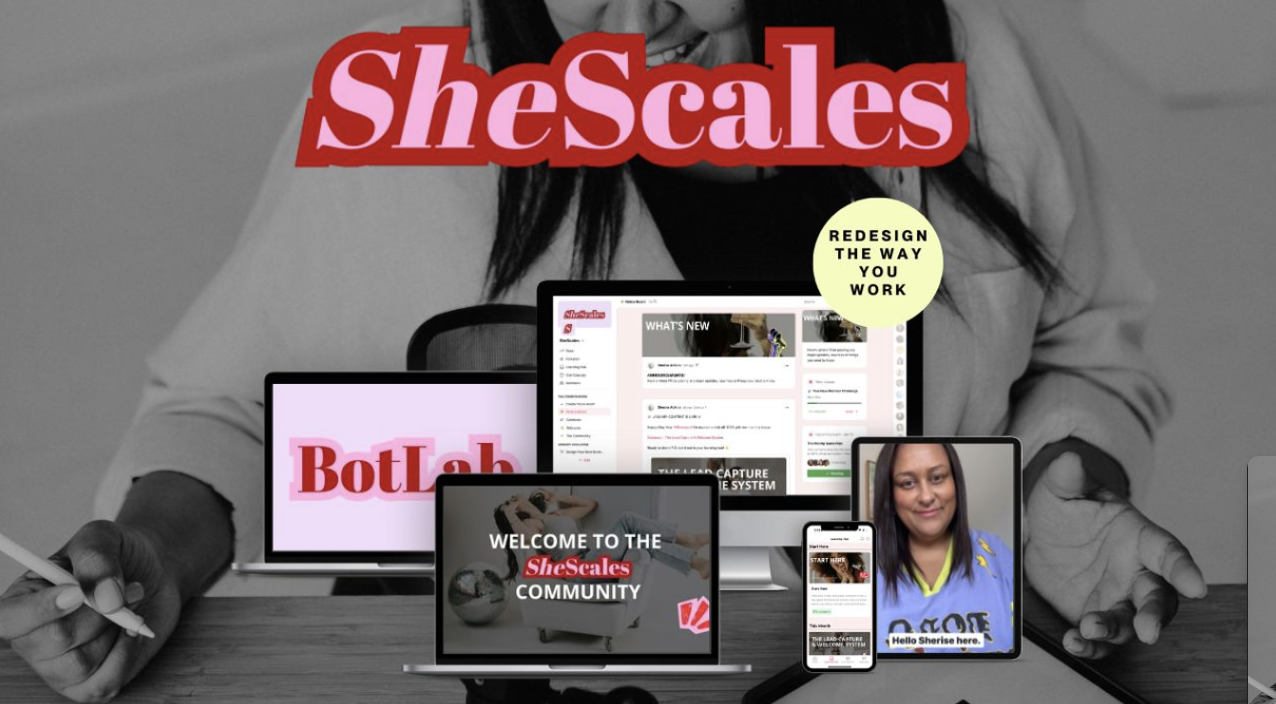
SheScales is an AI implementation community built specifically for solo founders. Not “solo-founder-friendly.” Not “also works for small teams.” Built for the person who is the business, the marketing team, the content creator, the client manager, and the CEO, all at once. If that's you, everything we build is built for your actual week.
The model is simple. Each month, I build a real system inside my own business. I pull it apart and explain every decision: why I structured it that way, what I tried that didn't work, what I'd change. Then I hand over every component so you can build your version. Not copy mine. Build yours, for your business, your voice, your clients, your tech stack, and your way of working.
Members have built client onboarding systems that run without them. Content workflows that take a brief on Monday and have posts scheduled in the next few minutes. Email systems that draft while they're on the school run. Pinterest strategies that batch a whole month in an afternoon.
And the ones getting those results aren't the most technical people in the room. They're the ones who did the foundational work first, their Brand Playbook, their voice, their offers, and then built systems on top of something solid.
There's something bigger at stake here too. AI is being shaped right now by who's in the room building with it. Right now that room is dominated by one kind of person building for one kind of business. If solo founders, and especially the women running one-person businesses, aren't in it, testing and building and saying out loud what works and what doesn't, we end up with tools designed for someone else, again. Being part of this now isn't only about saving time. It's about having a say in where it goes.
Who SheScales is for: Builders, not collectors. People past the “exploring AI” phase and ready to actually implement. If you want to consume content about AI, there's plenty of that for free. SheScales is for the person who wants to install AI into her business and have it run something.
Key Takeaways
The gap is fit, not size: Most AI content is built for a different kind of business: one with inventory, a pipeline, a support queue, an ad operation. Those problems don't shrink to fit a solo founder. They just don't exist in her business.
You're not behind: If AI hasn't delivered, it's almost certainly because the advice you followed was built for the wrong problems, and the advice that fits was buried. That's a fit-and-findability problem, not a capability problem.
The good stuff is a small pool, and it's hard to find: Content built for one-person businesses exists, but there's not much of it, and it's drowned out by enterprise and agency content. Most solo founders never dig far enough to reach it.
The question is wrong: “What can AI help me with?” keeps you using AI occasionally. “What part of my business should AI run?” is the question that leads to systems.
Foundation before tools: Generic output is almost always a context problem. Build the foundation first, your voice, your offers, your standards, and the same tools perform completely differently.
Frequently Asked Questions
Why doesn't most AI education work for solo founders?
Because most of it is built for a different kind of business: one with inventory, a sales pipeline, a support desk, an ad operation, or work that moves between people. Those use cases assume problems a one-person business doesn't have, so the advice doesn't transfer. It's not that solo founders need simpler AI. They need AI aimed at different problems entirely, the volume and repetition of running every function yourself.
I've tried several AI tools and can't get consistent results. What am I doing wrong?
Probably nothing about the tools. Inconsistent output is almost always a context problem: AI doesn't have enough specific information about your business, voice, audience, and standards to produce work that fits you. The fix isn't a different tool, it's building the foundation that gives AI what it needs. Document your brand voice, your offers, who your audience is, and what good output looks like for your specific business.
Is there actually anyone building AI education for solo founders?
Yes, but not many. There's a small pool of people genuinely building for one-person businesses, and the honest problem is that it's hard to find under the volume of enterprise and agency content. If you've searched and come away feeling like nothing fits, it's usually not that nothing exists, it's that the relevant material is buried. SheScales exists to be one of the places building squarely for this, in public, in a real solo business.
Do I need to be technical to get results with AI?
No. The results come from understanding your business well enough to brief AI properly: your voice, your standards, your audience, your offers. That's business knowledge, not technical knowledge. The setup itself, building an assistant, connecting tools, creating workflows, is learnable in hours. The strategic thinking about what to build and why is what drives the results, and that's something you already know how to do.
What should I build first if I'm starting from scratch?
Your Brand Playbook. Before any tool, assistant, or workflow, you need the document that tells AI how to sound like you, who your audience is, what your offers are, and what your standards look like. Everything else sits on top of that. Without it, AI produces generic output no matter how good the tool is. With it, even a basic setup starts producing output you'd actually use.
Is SheScales right for me if I'm just getting started with AI?
It depends what “getting started” means. If you've never opened an AI tool, Claude Unlocked ($47) is a better first step, it covers the foundations and gets your setup in place. SheScales is for people past the exploring phase and ready to build real systems. Most members arrive knowing the basics and frustrated they haven't been able to make AI properly work for their business. If that's you, SheScales is the right room.
What to Do Next
If this post named something you've felt but couldn't quite articulate, the sense that the AI advice you've been following wasn't built for your kind of business, trust that. It probably wasn't.
SheScales is my AI implementation community for solo founders. Every month you get a real system built for a solo business, fully explained and ready to make your own. No adapting enterprise content. No skipping the modules that don't apply. All of it built for the person who is the whole business and the whole team.
If you're ready to stop adjusting AI education to fit your business and start building AI that was designed for it from the ground up, this is where that happens.
See you in there.
MEET THE AUTHOR

HEY, I'M SHERISE
I'm an AI strategist and educator based on the Central Coast of NSW, Australia. I help solo founders install AI systems that scale their business without scaling their workload and remove low-value work from their business so they can spend more time in strategy, creativity, and the work that actually moves the needle.
I run SheScales, the AI implementation community built for the person who IS the business and the whole team. I'm the founder behind 40+ AI assistants across ChatGPT and Claude, the Brand Playbook App, and a growing library of skills and systems used daily by hundreds of solo businesses.
I teach the Architect Method: the shift from chatting with AI to giving AI a job. It's the thinking framework for spotting where AI can genuinely help in your business, knowing how to architect the system, and deciding whether something should be a Skill, a Project, a GPT, an automation, a combination of these, or stay manual.
I'm not here to inspire you. I'm here to hand you the architecture.