What Is an AI Architect (And Why Every Solopreneur Needs to Become One)
Last updated August 2026
I see the same thing over and over when I look at how solo founders are actually using AI in their businesses.
They've done a lot of the right things. They've probably set up Projects, GPTs, Skills, loaded in some context, added examples of their voice, maybe connected a tool or built a workflow. They're getting decent output. And because of that, they're thinking that's about as far as it goes.
Take someone building a content system. The version most people land on looks like this: one Project, and AI assistant with their platform knowledge loaded in, examples of their voice, and some formatting rules. They open it, they request content, it writes, it helps. That feels like the system.
But a content system built by an AI architect looks completely different (and it’s easier than you think to become an AI Architect). The research is automated…AI is finding trends, watching what's performing, and feeding that back into the strategy before they've opened a document. Content is drafted, formatted, and filed into their content management system. Auto-posting handles distribution. And then it loops: AI is reading the results, identifying what's working, and adjusting the strategy for next month. The human reviews, makes the calls that need a human, and fills in any context or strategy gaps. Everything else runs.
The gap between those two versions isn't technical knowledge or ability. It's the ability to see how far the thing can actually go.
An AI Architect is a business owner who has learned to look at a business function and ask: what does the fully built version of this look like? Not just "can AI help me with this", but how far can this actually go, and how do I build toward that? It's not a technical skill. It's a thinking skill, and it changes everything about how AI performs in your business.
By the end of this post, you’ll have:
What an AI Architect actually is — and what they see that most people don't
Why the gap isn't technical knowledge, and what it actually is
The five components of the Architect Method, and what each one looks like in practice
What changes in your business when you start thinking this way
How to start applying this to your own business right now
New here? This blog is for the solo founder who wears every hat in the business, and wants real AI systems and workflows running things, not just piecing it together in the chat. Start here →
What Is an AI Architect?
An AI Architect is someone who has learned to look at their business the way a designer looks at a building: not as a collection of individual tasks to get through, but as a structure that can be organised, connected, and made to function with less manual effort.
The AI user asks: "Can AI help me with this?" The AI architect asks: "What part of my business should AI be running, what does it need from me to do that well, and how do I build that?"
That's the shift. And it sounds subtle until you see how differently the two people work.
The AI user has prompts. The AI architect has systems that connect to all of their tools and automate their work.
The AI user starts each conversation from scratch. The AI architect's tools already know their brand, their offers, their audience, their standards, before they type a word.
The AI user gets varying results depending on how well they explain themselves that day. The AI architect gets consistent output because the context and strategy is already built in.
An AI Architect doesn't know more than you do. They see the same tools differently. They've learned to look at a workflow and ask: "What here should be running on its own?", and then they build that.
What's the Difference Between an AI User and an AI Architect?
The AI user isn't doing anything wrong. They're using AI, getting value, producing things they couldn't produce as quickly before. That's real. But their mental model of what's possible caps out somewhere around the first layer.
They want to build a content system, so they build a content assistant. They want to write emails faster, so they create an email workflow. They want help with client proposals, so they've got something set up for that too. Each thing does the job it was built for. None of them talk to each other. And the human is still the connective tissue between all of it.
The architect looks at the same situation and sees something different. Not "what can I use AI for today" but "what would this function look like if it ran properly?" They're thinking in layers: what's the first thing that needs to happen, what does that feed into, what does that connect to, where does the loop close? They build toward the full version, not just the first version.
Here's what that actually looks like on the content example:
The AI user's content system:
One AI assistant with platform knowledge and voice examples loaded in
Opens it when they need to write something
Gets decent output, edits it, posts it manually
Checks results separately, decides next week's content based on feel
The AI architect's content system:
Research layer: AI monitors trends and performance data, feeds insights back into the strategy
Creation layer: drafts, formats, and files content into the content management system automatically
Distribution layer: auto-posting handles scheduling across platforms
Feedback layer: results flow back in, strategy adjusts, the system learns what's working
The human reviews, makes creative calls, and focuses on what only a human can do
Same goal. Completely different scope. The architect isn't more technical — they just refused to stop at the first layer.
The key line: "A prompt is a question. A system is an employee." The user keeps asking questions. The architect has hired someone — and given them a department to run.
The Architect Method: Five Components of the Framework
The Architect Method is the thinking framework I teach inside SheScales. It's not a step-by-step process you follow once — it's a way of looking at your business that you apply continuously. Five components, each one building on the last.
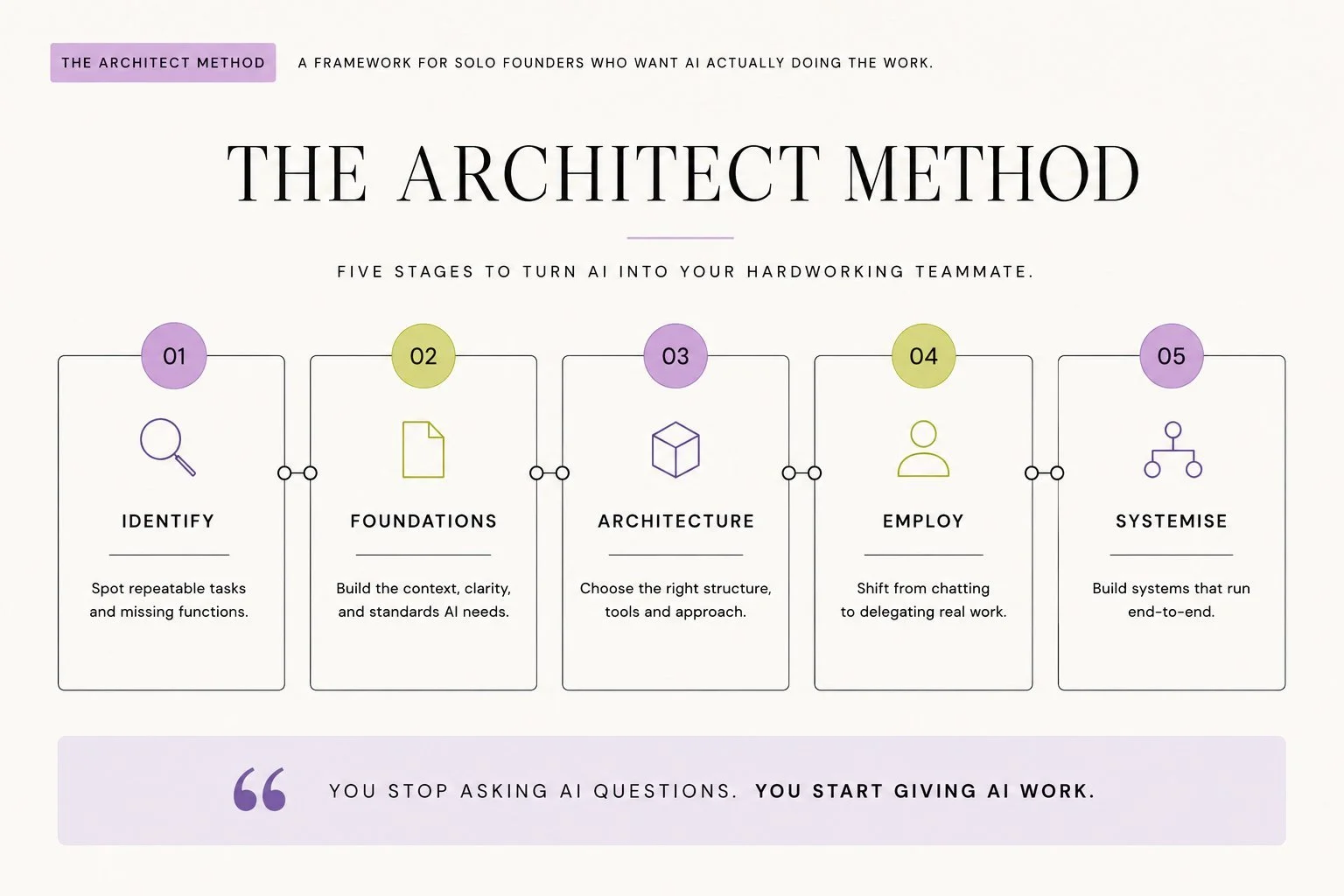
Identifying use cases. Look at your week and your business and spot two things. The tasks that are eating your time (the captions, the emails, the sales pages) and the functions that are missing entirely (the Pinterest strategy you don't have, the data review you can't get to, the follow-up sequence you keep meaning to build). If they are repeatable processes then they qualify and are jobs for AI.
Most people approach AI the other way around: they discover a tool, then look for a problem it might solve. The architect starts from the business. What's manual? What's repetitive? What are you doing every week that isn't the work — it's the scaffolding around the work? Those are your use cases.
When a SheScales member submitted this in her build request: "There's still a lot of human glue between steps" she'd already identified her use case. She'd spotted the gap. That's where architect thinking starts.
Knowing what to build. Once you've spotted a use case, work out what context AI needs to do the job well. This is the foundations layer. Your brand voice. Your audience. Your offers. Your standards. Your "never say" list. AI doesn't create clarity. It amplifies whatever's already there. If your foundations are vague, AI will produce vague output faster. If your foundations are documented, AI does the job almost without supervision.
Choosing the right architecture. Decide how to build it. Is this a Skill (a piece of reusable knowledge AI carries into every conversation)? A Project (a workspace with persistent context for one specific job)? A multi-step workflow that connects Claude to other tools? A Cowork task that runs autonomously? Or does this thing actually need to stay manual because the judgment can't be delegated yet? Tool selection matters, but it sits inside a bigger thinking framework.
This is where most AI education gets stuck. It teaches the tools without the decision-making framework. "Here's how to build an AI assistant" is useful. "Here's how to decide whether something should be a trained assistant, an automation, a connected workflow, or stay manual" is what actually changes how you work.
Choosing the architecture starts with knowing whether you need a prompt or a system. AI Prompts vs AI Systems works through that decision.
Shifting from chatting to employing. This is the mindset shift, and it's the hardest one. Most people are still using AI like a search engine with personality. The shift is from "help me write a caption" to "here's your job: produce this week's content using my brand voice, my pillars, and my schedule." You stop asking AI questions. You start giving AI work.
Giving AI a job means defining what it's responsible for, what it knows, what its output should look like, and what standard it should meet. It means writing the job description before you open the chat. It means thinking about AI as something you employ, not something you consult.
One standard worth building in from the start is honest pushback, and Why Claude Agrees With Everything You Say shows how to make Claude hold you to it.
Building systems, not collecting tools. A single tool doing a single job is helpful. A system running an entire function is transformational. My Pinterest workflow isn't one tool. It's a connected sequence: blog post in, pins titles and descriptions out, graphics created, pins scheduled, pins posted, tracked. That's a system. Most solo founders are still in the prompt-collecting phase. The win is one system that runs end-to-end.
Collections don't compound. You can have 40 AI tools and still be doing everything manually. Systems compound. You build once, and it runs.
This is the thinking that transfers across platforms. Tools change. The architecture thinking doesn't. Whatever Claude looks like in twelve months, the framework still works. That's the part worth investing your brain in.
The SheScales model: Each month inside SheScales, I build a real system in my own business, pull it apart, explain every decision, and hand over every component. Members build their version. The goal isn't to copy my system. It's to install it and adapt it to your business, and to develop the thinking that lets you architect your own.
Why Does This Have Nothing to Do With Being Technical?
The belief I see most often is that people are being held back by a technical gap. That there's some knowledge they haven't acquired yet that's keeping the good work out of reach. So they download more prompts, take more courses, watch more tutorials. And the gap stays exactly where it was.
What I've watched while working with people across a huge range of business types and experience levels is that the people who build the best AI systems aren't the most technical. They're the most willing to keep asking "and then what?"They keep pulling the thread.
That's not a technical skill. It's a disposition. It's the refusal to settle for the first thing the tool tells you it can do.
I'm not technical. I've never written code. None of that has stopped me from building 40+ AI assistants, a content system that runs across five platforms, a web app, and a community where I hand working AI infrastructure to solo founders every month.
The technical knowledge is almost never the bottleneck. The bottleneck is imagination, specifically the ability to see past the first layer of what's possible and keep building toward the version that actually runs the function properly.
What Changes When You Start Thinking Like an Architect?
The immediate change is efficiency. Tasks that took 45 minutes start taking 10. Content that required five rounds of editing starts coming back right on the first pass because you've built in the context AI needed. Email drafts, proposals, SOPs, social posts — the grunt work of running a business starts moving faster.
But the more interesting change is how you see your own business.
When you start mapping your workflows to figure out where AI fits, you realise things about how you actually operate that you hadn't consciously noticed before. You see the repetition. You see the bottlenecks. You see the tasks where you're the only person who could possibly do them versus the tasks where you're doing them manually out of habit, not necessity.
One SheScales member said it like this: "My business doesn't need more ideas. It needs consistent execution around a clear plan. I now know exactly what I'm focusing on, when I'm promoting, and where AI supports me."
That's not a productivity win. That's a shift in how she sees her business. The architect lens changes what you notice.
And then it compounds. Each system you build frees up time and mental space. That time and mental space goes into building the next system, or into the creative and strategic work that only you can do. The solo founder who architects her AI layer properly isn't working less. She's working on different things. The things that actually need her.
If you're already using Claude but haven't set up the infrastructure that makes this possible, the most important thing to build first is a Claude Project. After that, Claude Skills are what carry your brand voice and context across every conversation. And if you're connecting Claude to the tools you already use, Claude Connectors are the third piece.
Want the full Claude setup laid out step by step?
This free kit covers every setting worth turning on, how Projects and Skills work, and the exact prompt to export your ChatGPT memory so you're not starting from scratch.
It’s the guide I wish I had when I started!

Key Takeaways
The short version of everything above:
An AI Architect is defined by how they think, not what they know: The shift from AI user to AI architect is a thinking shift, not a technical one. It starts with learning to look at your business and ask: what here should AI be running?
The Architect Method has five components: Identify use cases, know what to build, choose the right architecture, shift from chatting to employing, and build systems instead of collections. Each one compounds on the last.
Context is the biggest lever: Mediocre AI output is almost always a context problem, not a tool problem. The architect invests in building the context first: brand voice, offer details, audience, standards. Everything else follows.
You already have the core skill: Strategic thinking is strategic thinking. If you can look at your business and identify what's working and what isn't, you can learn to apply that same thinking to where AI fits. The tools are learnable. The thinking you already have.
Systems compound, collections don't: One well-built system that runs a real function is worth more than 40 tools used occasionally. The architect builds once and benefits repeatedly.
Frequently Asked Questions
What exactly is an AI Architect?
An AI Architect is a business owner who has moved beyond using AI as a reactive chat tool and learned to deliberately structure AI into their business. They can identify where AI should take over a function, understand what context AI needs to do that job well, choose the right tools and structure, and build systems that run consistently without starting from scratch every time. It's a thinking framework, not a job title or a technical certification.
Do I need to be technical to become an AI Architect?
No. What separates an AI architect from an AI user isn't technical knowledge — it's the willingness to keep asking "and then what?" The architect builds the first layer and immediately thinks about what it connects to, what it feeds into, and how to close the loop. That's a disposition, not a skill set. The tool-specific knowledge is learnable in hours. The thinking that drives you to keep building deeper is what takes practice — and it's what SheScales develops.
What's the difference between an AI user and an AI Architect?
Both are using AI. The difference is scope. The AI user builds the first thing that works and stops there. The architect asks what the fully built version looks like — how the layers connect, where the loops close, how the system feeds back into itself over time. The user has a content Project. The architect has a content system that researches, creates, distributes, reads the results, and adjusts the strategy. Same goal. Completely different depth.
What is the Architect Method?
The Architect Method is the thinking framework taught inside SheScales. It has five components: identify use cases (spot where AI can genuinely take over something in your business), know what to build (understand what context AI needs from you), choose the right architecture (Skill, Project, GPT, automation, or manual), shift from chatting to employing (give AI a defined job, not a question), and build systems not collections (connect tools into end-to-end workflows that run real functions). Together, these components move a solo founder from occasional AI use to genuine AI infrastructure.
Where do I start if I want to think like an AI Architect?
Start with your business, not the tools. Look at your week and find the task you do most often that follows the same pattern every time. That's your first use case. Then ask: what would AI need to know about my business, my voice, and my standards to do this well? Build that context first. Then decide where it lives. That sequence — use case first, context second, architecture third — is the Architect Method in its most basic form.
Is the Architect Method taught inside SheScales?
Yes. It's the core thinking framework behind everything taught inside SheScales. Each month I build a real system in my own business, pull it apart, explain every decision that went into it, and hand over every component so members can build their version. The goal isn't to copy my system — it's to develop the thinking that lets you architect your own, for your specific business.
What to Do Next
If this is the first time you've encountered the idea of an AI architect, the most useful thing you can do right now is take 10 minutes and look at your business the way I've described: what are you doing manually every week that follows the same pattern? Where's the human glue between steps?
That question alone will show you your first use cases. And once you can see them, you can start building.
If you're still putting your Claude foundation in place, How to Actually Use Claude for Business is the right starting point, or Claude for Solopreneurs: The Complete Guide if you're running a solo business.
SheScales is where you build it properly. If you want to start architecting real systems with support, SheScales is the implementation community I run for solo founders who are done collecting tools.
Each month I build a new system in my own business, pull it apart, explain every decision, and hand over every component so you can build your version. It's for builders, not browsers.
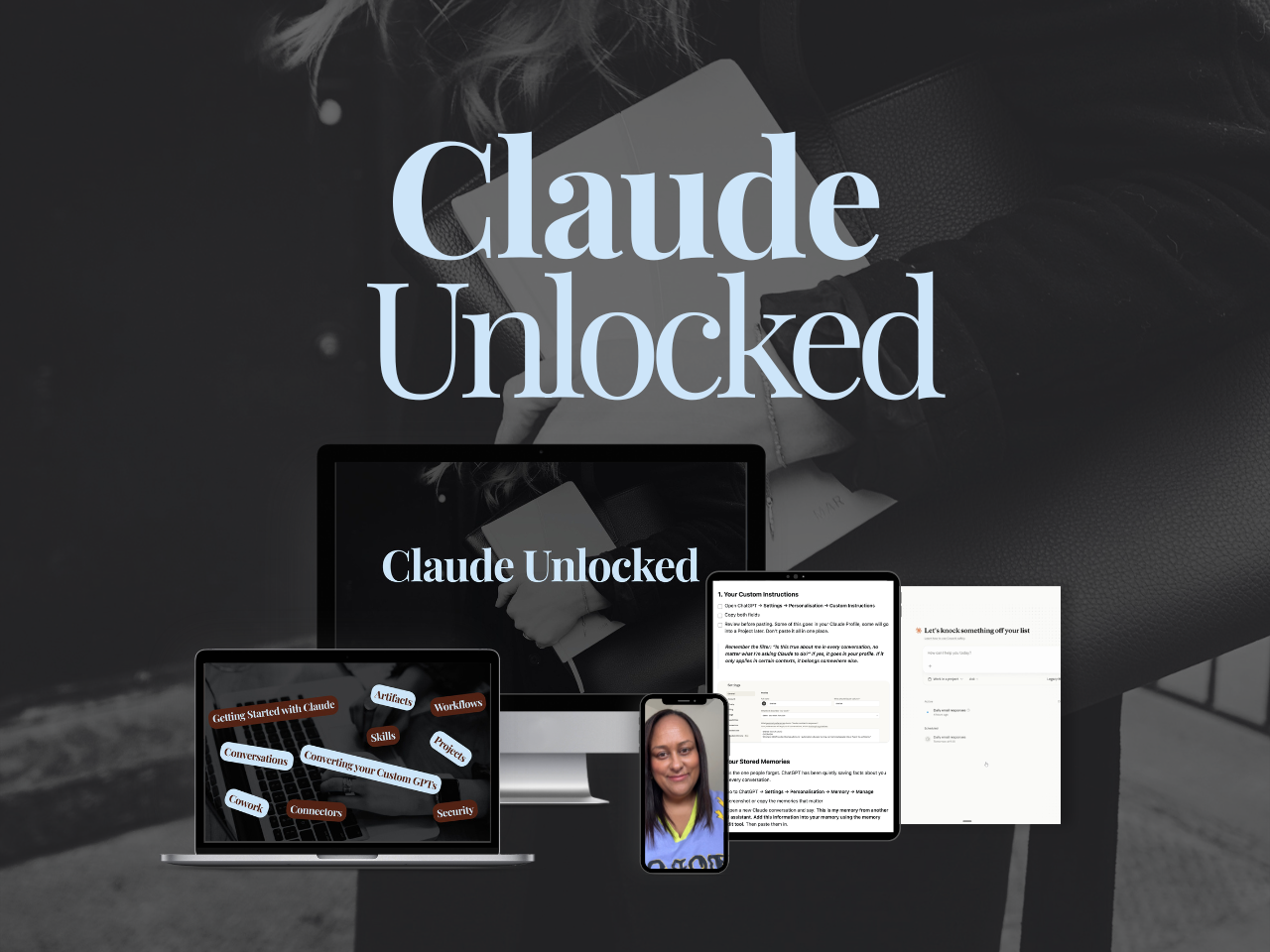
If you're not ready for SheScales yet, Claude Unlocked is the fastest way to get the technical foundation in place. Projects configured for your specific use cases, Skills that run your recurring work, Connectors that link Claude to the tools you already use, tasks running without you sitting there watching - that's what Claude Unlocked covers.
It's $47 for a limited time and takes an afternoon to complete.
MEET THE AUTHOR

HEY, I'M SHERISE
I'm an AI strategist and educator based on the Central Coast of NSW, Australia. I help solo founders install AI systems that scale their business without scaling their workload and remove low-value work from their business so they can spend more time in strategy, creativity, and the work that actually moves the needle.
I run SheScales, the AI implementation community built for the person who IS the business and the whole team. I'm the founder behind 40+ AI assistants across ChatGPT and Claude, the Brand Playbook App, and a growing library of skills and systems used daily by hundreds of solo businesses.
I teach the Architect Method: the shift from chatting with AI to giving AI a job. It's the thinking framework for spotting where AI can genuinely help in your business, knowing how to architect the system, and deciding whether something should be a Skill, a Project, a GPT, an automation, a combination of these, or stay manual.
I'm not here to inspire you. I'm here to hand you the architecture.