How to Start a Business With Claude (Before You Have One)
Last updated August 2026

A few dozen times a month, someone types some version of "how to start a business with Claude" into Google and lands on a post I wrote for people who already have one. Right question, wrong post. Sorry about that 😅.
I’ve come to realise that there’s something almost every Claude guide assumes: that the business already exists. Existing offers, an existing brand voice, a folder of content to load into a Project. If none of that exists yet, that advice is standing one step ahead of where a lot of people actually are.
So this is the post for before. Before the offer, before the brand voice, before there's anything to load in at all.
One honest note, since the title says Claude. Most of this would work in another AI too, and I'm not going to pretend otherwise. But two things make me reach for Claude for this particular job: it pushes back instead of nodding along, which is exactly what you want when you're a little in love with your own idea, and its writing lands closer to human on the first go, so the positioning and the sales page take less wrestling. If you run your business in ChatGPT, the steps still hold. This is just how I do it.
Before you have a business, Claude earns its keep as a pressure-test: for the idea, the positioning, the first offer, and the first sales page. You find the holes in a fifteen-minute chat instead of three months into building.
TL;DR:
Claude's best job on a new idea is devil's advocate, not cheerleader. Ask it to argue against your idea before you spend a weekend building around it.
You can research your ideal client before you've met one. Get Claude to surface the words people already use about a problem, instead of you guessing at a persona.
Write the one-line pitch before the full offer. For who, what, unlike what, why. If it won't hold up in a sentence, the offer under it usually won't either.
A rough sales page is a one-sitting job, not a three-day grind. It's still worth rewriting once real customers turn up.
Claude can't have the idea for you. It can only pressure-test the one you've already got.
New here? This blog is for the solo founder who wears every hat in the business and wants real AI systems and workflows running things, not just piecing it together in the chat. Start here →
Here’s what we’ll be covering:
Before we get into the how, I want to share something important with you. According to CB Insights, poor product-market fit is the leading root cause of startup failure, at 43%. Running out of money gets blamed more often, but that's usually the last thing that happens, not the first thing that went wrong. Which is the whole argument for doing this in order: check the idea before you build the thing.
To make the concepts in here more concrete for you, I'll run one real business idea through every step as we go so you can see how each step unfolds.
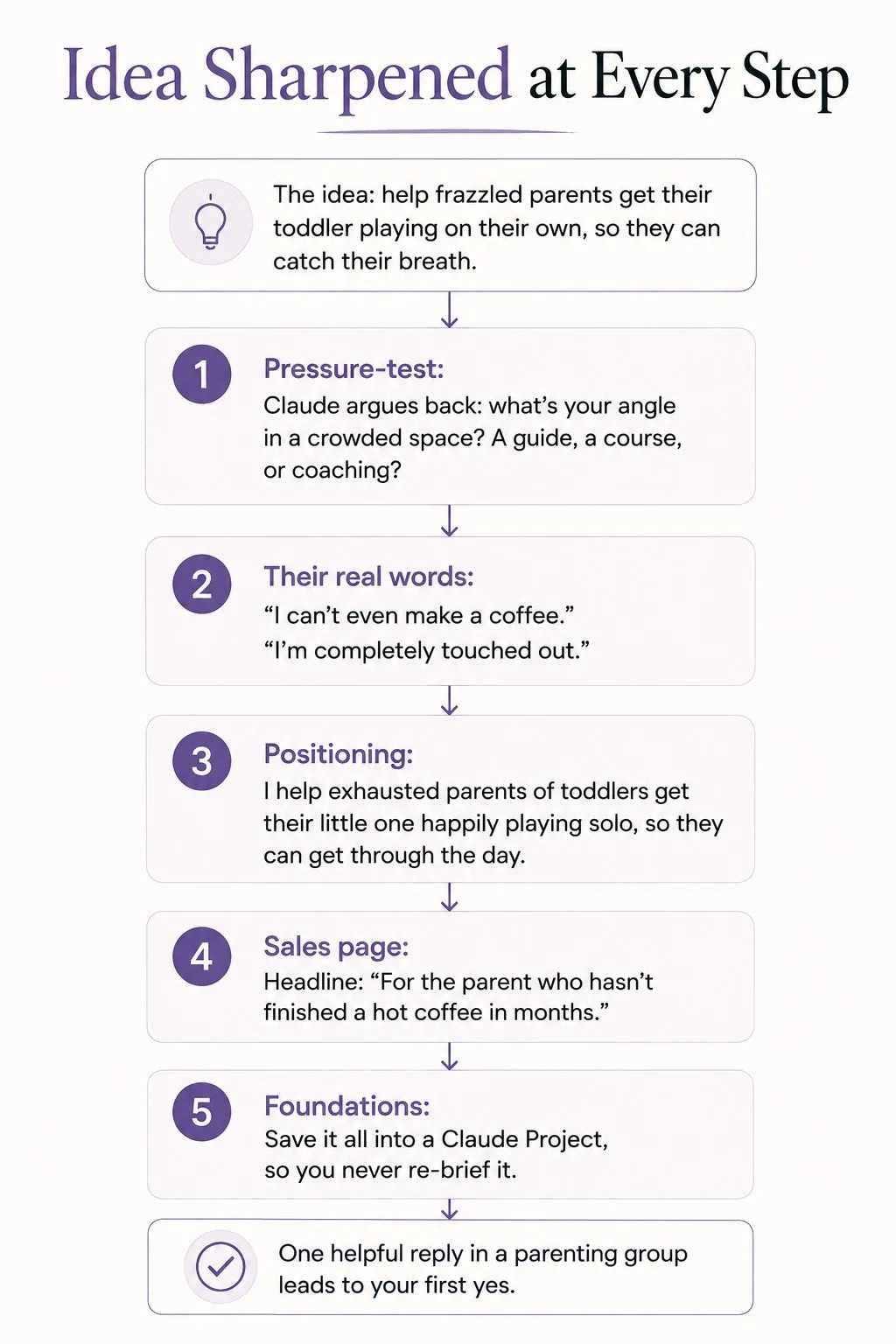
THE BUSINESS IDEA: Helping frazzled parents get their toddler happily playing on their own, so they can get through the day and catch their breath. Watch how it sharpens at each stage.
Haven't Landed on an Idea Yet? Start Here
If you don't have an idea yet, don't try to force one out of thin air. The good ones almost always come from two places: what you already know, and what already annoys you.
Claude is useful here as an interviewer, not an idea vending machine. Give it your raw material and let it find the overlaps you're too close to see:
I'm trying to work out a business I could start. Interview me one question at a time about my skills, the things people ask me for help with, the problems I've solved for myself, and what I find myself ranting about. When you've got enough, give me five directions where something I know meets a problem real people would pay to solve, and tell me which two are worth pressure-testing first.
You're not asking Claude to hand you a business. You're using it to spot the pattern in your own experience that you can't see because you're standing in it. Pick the direction that makes you lean in, and take it into the next step.
Pressure-Test Your Idea Before You Build Anything
Now that you’ve got your idea I know you’ll be tempted to run full steam ahead.
But before you spend a weekend building around an idea, I’d love you to spend just fifteen minutes trying to break it. That’s what’s going to make your idea stronger, which is what you want if you want your business to actually work.
Claude's most useful job here isn't coming up with ideas. It's arguing with the one you've already got, and this is the step where its habit of pushing back genuinely earns the pick. It's more willing to tell you the idea has a hole in it than ChatGPT, which tends to look for the bright side. When you're the one who dreamed the idea up, you want the one that argues. You paste your idea in as a plain paragraph, not a polished pitch, and you set it loose:
I want you to pressure-test a business idea, not encourage it. Take the role of a sceptical potential customer who has been burned before and has no reason to be polite.

Here's the idea: [describe it in plain language, including who it's for and roughly what it costs].

First, ask me anything you need to judge it fairly. Then give me:
1. The three strongest reasons this fails or stays small.
2. Who already solves this problem. Search for real examples, and say clearly when you're not sure instead of inventing names.
3. The single change that would make the idea hardest to argue with.

Don't soften it to be nice. I'd rather hear it now than after I've built the whole thing.
What comes back is either a few competitors you didn't know were there, or a sharper version of your own idea once you've watched it get poked at. Both are useful. Both are a lot cheaper to find out now than after you've built a website around it.
A shaky idea costs you fifteen minutes in a chat. It costs you a great deal more once there's a brand, a logo, and a launch attached to it.
Run our example through it and Claude might come back with: parenting is a crowded space, there are big free accounts already teaching independent play, so what's your actual angle, and is this a guide, a course, or a coaching offer?
That's not a no. That's the idea getting sharper before you've spent a cent.
Want Claude set up properly before you run any of this?
My free Claude Setup Kit walks you through every setting worth turning on, how Projects and Skills work, and the exact prompt to pull your ChatGPT memory across so you're not starting from a blank slate.
It's the guide I wish I'd had on day one.

Find Your Ideal Client Before You've Met One
You don't need customers yet to find the words your future ones already use.
Ideal client research usually assumes you've got a list to survey or a community to lurk in. Before either of those exists, Claude can still help you find the shape of the problem, as long as you don't ask it to invent the answer for you.
I'm researching the people who would buy [rough offer] to solve [problem]. I have no customers yet, so I need their real language, not a made-up persona.

Search forums, reviews, Reddit, and social posts where people actually talk about this problem. Pull out:
- The exact phrases they use to describe it. Quote them.
- What they blame it on.
- What they've already tried that didn't work.

Only use things you can genuinely find. If a source is thin, tell me. Don't fill the gap with a guess.
With web search or a connector switched on, Claude pulls from live sources instead of guessing at persona language from memory. Without it, treat what comes back as a hypothesis to go and test against real conversations, not a finished profile.
The goal isn't a tidy persona document. It's the exact words someone would use to describe this problem to a friend over coffee. Those words are what your sales page gets built out of later, so it's worth collecting them now.
For the toddler idea, this surfaces the real phrases: "he won't play by himself for five minutes," "I can't even make a coffee," "I'm completely touched out." That's what goes on the page. Not "busy mums."
Build Your Positioning and Your First Offer
Positioning is the one thing worth getting uncomfortable with before you go anywhere near a price.
Once you roughly know who this is for and what they're up against, the next job is saying, in a single sentence, what you actually sell and why it beats whatever they'd reach for instead.
The trick is to write it about your customer, not you. That's the whole idea behind the StoryBrand one-liner: your customer is the hero, you're just the thing that gets them where they're going.
Help me write my positioning as one clear sentence, then stress-test it.

Here's what I know: my idea is [x], it's for [rough audience], and the free or cheap thing they'd reach for instead is [alternative].

Use this shape, where my customer is the hero and I'm not: "I help [specific person] [solve a specific problem or reach a specific goal] so they can [the transformation they actually want]."

Give me three versions, each more specific than the last. Then take the strongest one and run three checks on it:
- Is my customer the hero of the sentence, or am I?
- Is it specific enough that the wrong person would rule themselves out?
- Does the "so they can" part name a real change, not just "save time"?

Tell me where it falls down, then fix it.
Run our example through, and it lands somewhere like: "I help exhausted parents of toddlers get their little one happily playing on their own, so they can get through the day without feeling stretched to breaking point."
Specific enough that a parent of an easy, settled toddler quietly rules themselves out, which is exactly the point.
If that one sentence wobbles, the offer sitting underneath it usually wobbles too. Fix the sentence first. It's faster than fixing an offer you've already priced and packaged.
Draft Your First Sales Page
A first sales page doesn't need three days when you use Claude.
With the positioning and the offer roughed out, Claude can turn them into an actual draft in a single session.
This is the other place the tool genuinely matters to me: Claude's first draft tends to read more like something a person actually wrote, so you spend your time editing rather than stripping out the robot-speak.
Draft a short sales page I can react to and rewrite, not publish as-is.

Positioning: [paste from above]. Offer: [what's included, price, format]. Audience: [who it's for].

Structure it in this order:
- An audience callout line at the top: "For [who]..." so the right person knows they're in the right place.
- A headline that promises the outcome, not the product.
- The problem in their own words.
- What changes for them once they have this.
- What's included, with every item written as what it does for them, not what it is.
- One honest objection, with a straight answer.
- The price, and one clear next step.

Keep it plain and specific. Real numbers and timeframes over words like "fast" or "affordable." No hype, nothing like "unlock" or "transform," no exclamation marks. Wherever you've had to assume something about my offer, flag it in brackets so I can fix it.
The first draft's job is not to be publishable. Its job is to give you something to react to, because reacting to a real page is ten times easier than starting one. So react to it, rewrite the bits that don't sound like you, and put it up. Done beats perfect when you've got no customers yet anyway.
For our example, the audience callout almost writes itself: "For the parent of a toddler who hasn't finished a hot coffee in months." And the headline promises the outcome, a toddler who'll happily play on their own for twenty minutes, not the product, a PDF.
How Do You Set Claude Up for Your New Business?
Everything above is worth saving somewhere Claude can see it every time, not just trapped in the one conversation where it happened.
Take what you've built so far, the idea, the audience language, the positioning and the offer, and drop it into a Claude Project. Now every future conversation starts with that context of your business and offer already loaded instead of you retyping it from scratch. How to Build a Claude Project walks through the setup itself.
Most people build this project eighteen months in, after eighteen months of generic output. You get to build it on day one. That's the whole advantage of starting this way.
Our toddler-play founder saves the lot, the parent language, the positioning line, the offer, into one Project.Six weeks later, when she asks Claude for an Instagram caption, it already knows exactly who she's talking to and how she describes the problem. She never re-briefs it.
That's the difference between a saved workspace and a one-off chat, where the context dies the moment you close the tab. Claude does this with Projects, and ChatGPT does it now too, so the point isn't which logo you pick. It's that you build the context once, on day one, instead of retyping it forever.
What Claude Can't Do For You
This is where I'd rather be straight with you than oversell the tool.
Claude can't have the idea for you. It can't sit across from your first real customer and hear the hesitation in their voice before they say yes or no. And it can't decide, on your behalf, whether this is actually the business you want to spend the next year of your life building.
What it does is make the deciding faster and better informed. The pressure-test, the research, the draft. The deciding itself stays yours, and honestly, that's the part you'd want to keep anyway.
How Do You Get Your First Customer?
A sales page nobody sees teaches you nothing. The scariest step, and the one that actually tells you whether any of this works, is getting it in front of one real person.
You don't need an audience for that. You need a conversation. Claude can help you find where your people already gather and write the first message that doesn't read like a pitch:
My offer is [paste your positioning]. Where do the people I described already gather online, in specific forums, subreddits, Facebook groups, or communities? For the two best ones, write a short, genuine message I could post or send that leads with help and only mentions what I'm building if it's actually relevant. No hard sell.
For the toddler idea, that's the parenting subreddits and the "my toddler won't nap" Facebook groups, and a message that answers someone's independent-play question properly before it ever mentions a product.
Your first customer almost never comes from a launch. They come from a conversation where you were useful first. And that conversation tells you, faster than any amount of planning, whether the thing you've built is one people actually want.
Key Takeaways
The short version:
Pressure-test before you build. Get Claude to argue against your idea before you spend real time or money building around it.
Research the language, not the persona. Claude can surface how people already describe a problem, so you've got real words before you've got real customers.
One sentence before one offer. If your positioning won't hold up in a single line, the offer built on top of it usually won't either.
A rough draft beats no draft. A sales page written in one sitting gives you something to react to and rewrite, not something to publish untouched.
Claude pressure-tests. You decide. It can't have the idea, meet your first customer, or pick the business for you. Those parts stay yours.
Get it in front of one real person. A sales page nobody sees teaches you nothing. Your first customer comes from a useful conversation, not a launch.
Frequently Asked Questions
Can Claude help me if I don't have a business idea yet?
Yes, up to a point. It can't conjure a business from nothing, but it's genuinely good at interviewing you about what you already know and what frustrates you, then turning that into a few directions worth testing. There's a prompt for exactly that in the "no idea yet" section above. Then you bring the direction you like best to the pressure-test.
Is the free plan enough to start with?
For validating an idea and running a handful of the prompts in this post, yes. Every plan has usage limits that reset on a rolling window, so light, occasional use sits comfortably on the free tier. Once you're in Claude every day, researching, drafting, and running the thing, you'll want more room than the free plan gives you.
What should I set up first, before I have any customers?
Your idea, your audience language, and your positioning, saved somewhere Claude can see every time, not just in the one chat where you worked it out. That's exactly what the foundations step above is for.
Can Claude actually write my sales page, or do I need a copywriter?
It can write a genuinely usable first draft, headline, problem, offer, objection and all. It won't sound exactly like you until you teach it your voice, but it hands you a full page to edit instead of a blank document to stare at, and that's most of the battle when you're starting out.
What to Do Next
Start with the idea you already have, not the perfect version of it you're waiting to think of.
Run it through the pressure-test prompt tonight. If it survives, work through the ideal client research, the positioning, and a first sales page draft over the next week, not the next quarter.
If you want your Claude settings and structure sorted properly so your business has something solid to run on, Claude Unlocked is the natural next step.
It walks through Projects, Skills, Connectors, and Cowork in the order they actually matter for a business owner.
It's $47 for a limited time and takes an afternoon to complete.
MEET THE AUTHOR

HEY, I'M SHERISE
I'm an AI strategist and educator based on the Central Coast of NSW, Australia. I help solo founders install AI systems that scale their business without scaling their workload and remove low-value work from their business so they can spend more time in strategy, creativity, and the work that actually moves the needle.
I run SheScales, the AI implementation community built for the person who IS the business and the whole team. I'm the founder behind 40+ AI assistants across ChatGPT and Claude, the Brand Playbook App, and a growing library of skills and systems used daily by hundreds of solo businesses.
I teach the Architect Method: the shift from chatting with AI to giving AI a job. It's the thinking framework for spotting where AI can genuinely help in your business, knowing how to architect the system, and deciding whether something should be a Skill, a Project, a GPT, an automation, a combination of these, or stay manual.
I'm not here to inspire you. I'm here to hand you the architecture.