AI Prompts vs AI Systems: What Solo Founders Should Build
Last updated August 2026
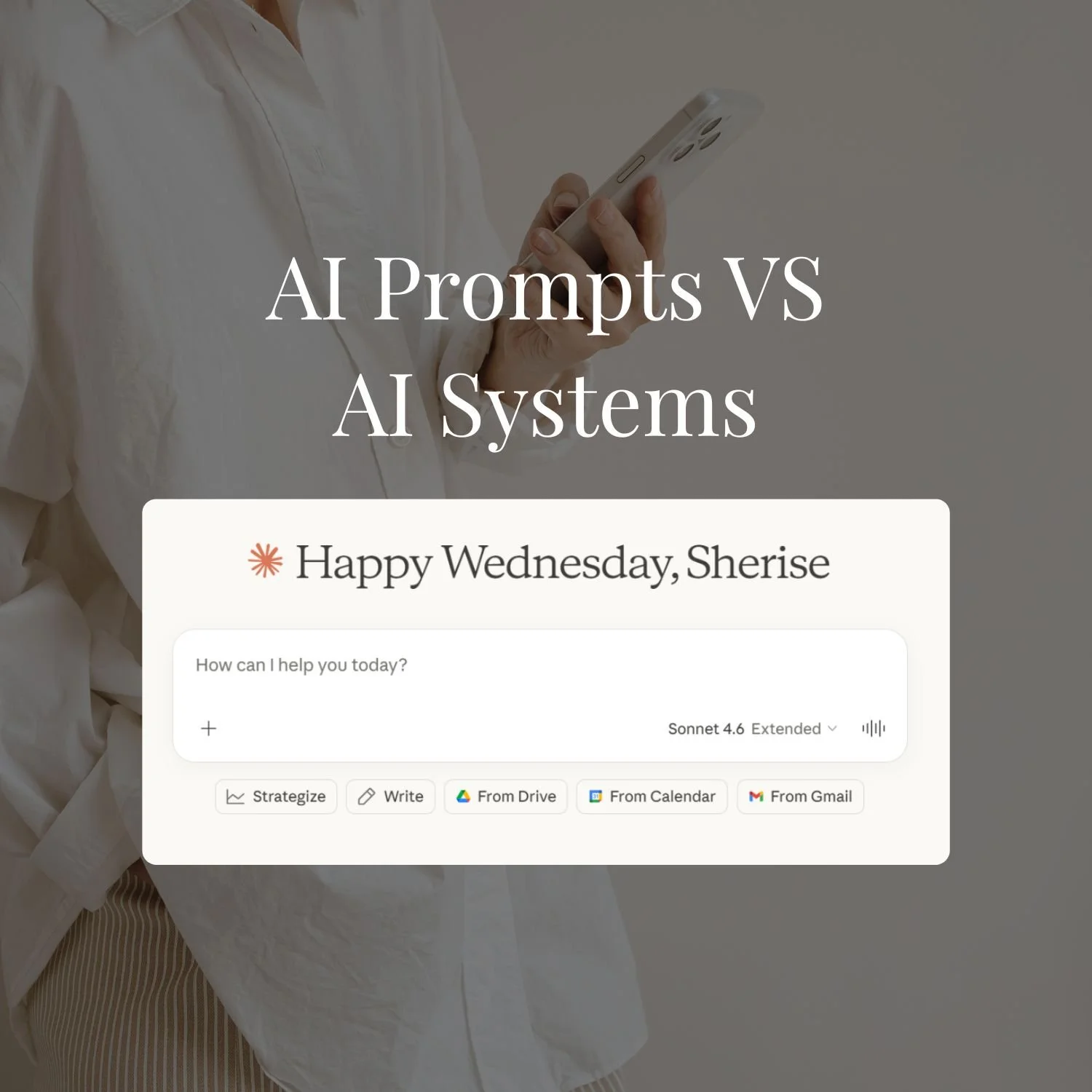
You know the folder. The Notion page, the saved chat, the screenshot album on your phone, wherever the good prompts live. You’ve collected them because they work, and collecting them was the smart move at the time 🤪.
Here’s what I want to hand you today: the reason the folder never quite adds up to the time savings you were promised, and what to build instead.
A prompt is a question. A system is an employee. Saving better questions makes you a better asker. It doesn’t take anything off your plate, because you’re still in the middle of every single task, feeding the machine.
An AI prompt gets you one output, once, with you supplying the context every time. An AI system is a defined job with your business context, your standards, and your process built in, so the work runs the same way whether you have capacity that day or not.
Not sure which of your tasks is worth systemising in the first place? AI for Solo Founders: The Use Cases That Actually Apply to Your Week is the place to start.
TL;DR:
A prompt produces one output and forgets you immediately. A system carries your brand voice, offers, and process into every piece of work without being reminded.
Prompt collections fail for a structural reason: the context lives in your head, so you have to be present for every task. That's the part a system removes.
You don't need to be technical to build systems. A Claude Project holds the context, a Skill holds the process, and connectors link it to the tools you already pay for.
The fastest path is converting one prompt you already reuse into a system this week, then repeating. One real function running beats fifty prompts saved.
New here? This blog is for the solo founder who wears every hat in the business and wants real AI systems and workflows running things, not just piecing it together in the chat. Start here →
Why Your Prompt Library Isn’t Saving You Time
A prompt library grows every week and somehow the workload doesn’t shrink with it. The instinct behind collecting prompts is right: you found something that works and you kept it. The problem sits one layer deeper.
Every saved prompt still needs you to show up, remember it exists, find it, paste it in, add the context (“here’s my audience, here’s my offer, here’s the tone”), check the output, fix the output, and move the result to wherever it actually needs to go. The prompt handled one step. You handled the other seven.
This is a structural problem, and the wider industry has started saying it out loud. Forbes reported in March 2026 that reusable AI skills are replacing prompts for small businesses, and Taskade’s analysis of prompts vs workflows lands on the same four weaknesses: prompts are fragile, they don’t remember your history, they’re disconnected from your tools, and they wait for you.
That last one is the killer for a solo founder. You are the only person in the building. Anything that waits for you is, functionally, still your job.
The takeaway: the prompt was never the bottleneck. You being required at every step was.
A Prompt Is a Question. A System Is an Employee.
“Help me write a caption” is a chat. “Here’s your job: create this week’s content using my brand voice, content pillars, and posting schedule” is a job. That’s the whole shift, and it changes what you build.
When you hire a person, you don’t hand them a sticky note of instructions every morning and take it back at 5pm. You onboard them once. They learn your offers, your standards, your way of doing things, and then they run the function. You review the work, you don’t produce it.
An AI system is built the same way. It has three ingredients:
Context: what the system knows. Your brand voice, your audience, your offers, your standards. In Claude, this lives in a Project.
Process: how the work gets done. The steps, the format, the rules, the quality bar. This is what a Skill carries.
Connection: where the work flows. Connectors link Claude to the tools you already pay for, so the output lands in your email platform or your content database instead of a chat window you copy-paste from.
A prompt has none of the first, none of the second, and none of the third. It’s a question, asked well.
The takeaway: stop optimising your questions. Start writing job descriptions.
What an AI System Looks Like in a One-Person Business
A system is when a whole function runs with you reviewing instead of producing. Not a robot business, and not you removed from the decisions. You removed from the repetition. Which function to turn into a system first is its own question, and I cover it in what to automate first.
Two real ones from my own business:
My email drafting runs through Kit. Claude drafts directly in my email platform, in my voice, with my offers and my list context already loaded. When I open my laptop, drafts are sitting there waiting for me to review and hit send. The writing happened without me; the judgment is still mine.
My Meta ads reporting used to be a log-in-and-squint job. Now the performance data gets pulled and analysed against my own kill/keep/scale rules, and I read a verdict instead of a dashboard. Same decisions, a fraction of the time spent arriving at them.
Notice what both have in common: they’re not one clever prompt. They’re context plus process plus connection, wired into tools I was already paying for. This is exactly the kind of system we build together each month inside SheScales: members get the full build pulled apart, every component handed over.
The takeaway: a system isn’t more AI. It’s the same AI, given a proper job.
How to Turn a Prompt You Already Use Into a System
Your best prompt is a system that hasn’t been onboarded yet. Here’s the conversion, step by step.
Pick the prompt you reuse most. Repetition is the tell. If you’ve pasted it more than three times, it qualifies. If it’s a repeatable process, it’s a job for AI.
Write down everything you add to it manually. The audience notes, the tone corrections, the “actually, make it sound more like me” follow-ups. That list is your context, and it’s currently living in your head.
Move the context into a Claude Project. Brand voice, offers, audience, standards. Build it once. Every conversation inside that Project starts already knowing your business.
Turn the process into a Skill. The steps you always follow, the format you always want, the rules you always repeat. A Skill fires automatically when the task matches, so you brief the idea and it handles the how. (I’ve broken down how Skills work here.)
Connect the output to where it lives. Email platform, content database, scheduler. The moment the output lands in the right tool without a copy-paste, you’ve stopped being the courier.
Do this for one function and run it for a fortnight before you build the next one. One system bedding in properly beats three half-built ones (ask me how I know 😅).
This shift in thinking, spotting the use case, knowing what to build, choosing the architecture, is the Architect Method, and it’s the difference between someone who uses AI and someone who directs it.
The takeaway: convert one prompt this week. The second system is easier than the first.
Want the full Claude setup laid out step by step?
This free kit covers every setting worth turning on, how Projects and Skills work, and the exact prompt to export your ChatGPT memory so you're not starting from scratch.
It's the guide I wish I'd had when I started.

Key Takeaways
The short version of everything above:
A prompt is a question, a system is an employee: prompts produce one output with you supplying the context every time; systems carry your context, process, and connections so the function runs without re-briefing.
Prompt libraries fail structurally, not personally: the context lives in your head, so every saved prompt still requires you at every step. That’s the layer a system removes.
Every system has three ingredients: context (a Claude Project), process (a Skill), and connection (connectors to the tools you already pay for). A prompt has none of them.
Convert, don’t start over: your most-reused prompt already contains the job description. Move its context into a Project, its process into a Skill, and its output into the right tool.
One function at a time: run one system for a fortnight before building the next. Depth beats collection, in prompts and in systems.
Frequently Asked Questions
What’s the difference between an AI prompt and an AI system?
A prompt is a single instruction that produces one output, with you supplying the context each time. An AI system is a defined job with your business context, process, and tool connections built in, so the work runs consistently without re-briefing. The practical difference is where the context lives: in your head (prompt) or in the setup (system).
Do I need to be technical to build AI systems?
No. Building a system in Claude means writing clear instructions in plain English, uploading them once, and connecting the tools you already use. If you can write a detailed brief for a freelancer, you can build a system. I’m not technical, and every system in my business was built without writing code.
Can one person really run AI systems alone?
Yes, and solo founders are arguably the best positioned to do it. You already know every process in your business because you run every process in your business. That knowledge is exactly what a system needs. The build is documenting what you already do, not inventing something new.
Where should I build my first AI system?
Start with the task you re-explain most often. For most solo founders that’s content: captions, emails, or blogs, because the voice and format rules are stable and the task repeats weekly. Convert that one prompt into a Project plus a Skill, run it for a fortnight, then pick the next function.
How does SheScales help with this?
SheScales is my AI implementation community for solo founders. Each month I take a real system from my own business, pull it apart, explain every decision, and hand over every component so you can build your version. It exists because most AI education is built for businesses with teams, and you are the team.
What to Do Next
If you’ve got a folder of prompts, you’re closer than you think. The raw material is already there; it just needs onboarding.
Convert one prompt this week. That’s the move.
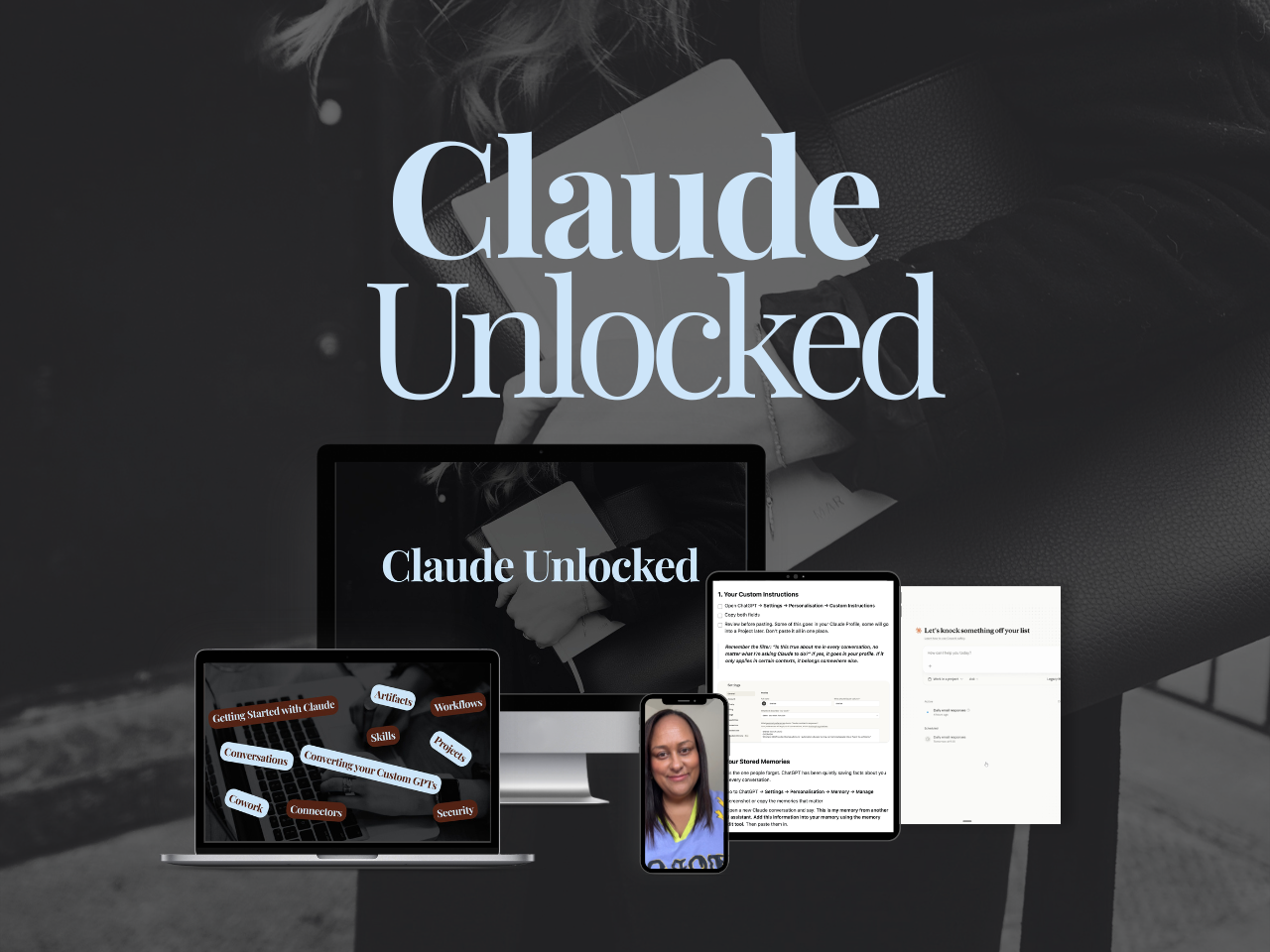
If you’re starting out, Claude Unlocked gets your foundation right: Projects, Skills, and Connectors set up properly for your business. It’s $47 for a limited time and takes an afternoon to complete.
And if you’re ready to build actual systems with the build pulled apart in front of you, SheScales is where it happens. I walk you through it on live calls, I’m in the community daily answering questions, and you’ve got a room full of solo founders building alongside you. The kind of room where things actually get done instead of bookmarked.
It’s $77/month or $770/year, and it’s for builders, not browsers.
MEET THE AUTHOR

HEY, I'M SHERISE
I'm an AI strategist and educator based on the Central Coast of NSW, Australia. I help solo founders install AI systems that scale their business without scaling their workload and remove low-value work from their business so they can spend more time in strategy, creativity, and the work that actually moves the needle.
I run SheScales, the AI implementation community built for the person who IS the business and the whole team. I'm the founder behind 40+ AI assistants across ChatGPT and Claude, the Brand Playbook App, and a growing library of skills and systems used daily by hundreds of solo businesses.
I teach the Architect Method: the shift from chatting with AI to giving AI a job. It's the thinking framework for spotting where AI can genuinely help in your business, knowing how to architect the system, and deciding whether something should be a Skill, a Project, a GPT, an automation, a combination of these, or stay manual.
I'm not here to inspire you. I'm here to hand you the architecture.